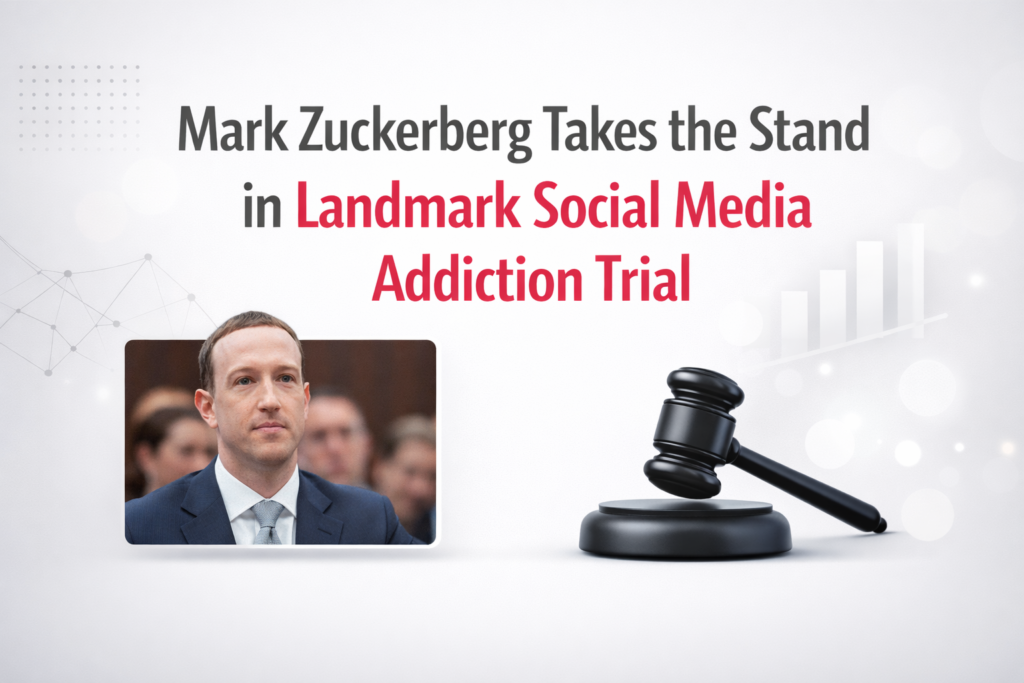
A courtroom in Los Angeles became the stage for one of the most consequential tech cases of the decade.
On Wednesday, inside a packed California courtroom, Mark Zuckerberg faced a jury — not lawmakers, not regulators, but everyday citizens.
For the first time, he testified directly in a landmark trial accusing Meta and other platforms of engineering addictive social media experiences that harm children.
The question at the heart of the case is simple — and explosive:
Are social media platforms designed to connect people?
Or are they designed to hook them?
The “Digital Casino” Allegation
The lawsuit, brought by a 20-year-old Californian identified as K.G.M., argues that platforms including Instagram and YouTube were engineered to create compulsive behavior — comparing them to slot machines and cigarettes.
Her legal team described the apps as “digital casinos,” built to maximize engagement at the expense of young users’ mental health.
Internal documents presented in court showed executives discussing user engagement in ways that drew parallels to gambling and addictive products. A 2015 memo encouraged prioritizing increased time spent by teenagers on Meta’s apps.
Meta has denied the allegations.
The company argues that its platforms provide value — and that increased usage reflects that value, not manipulation.
A Global Reckoning Over Youth and Screens
The case unfolds against a backdrop of mounting global concern.
In 2024, the U.S. Surgeon General called for warning labels on social media platforms, citing associations with adolescent mental health harms.
Countries like Australia have moved to restrict access for users under 16. Others, including Malaysia, Spain, and Denmark, are considering similar legislation.
The cultural shift is clear:
Social media is no longer viewed as neutral infrastructure.
It is being scrutinized as a behavioral system.
Zuckerberg’s Defense: Value, Not Addiction
On the stand, Zuckerberg kept his answers concise.
Instagram, he argued, is not inherently harmful. It is a valuable service. And people use valuable services more.
When confronted with decade-old internal communications suggesting awareness of youth vulnerability, he repeatedly stated:
“You’re mischaracterizing this.”
He challenged the relevance of old emails and rejected interpretations that framed engagement strategy as predatory design.
Meta’s legal team also argued that the plaintiff’s mental health challenges stemmed from complex personal circumstances unrelated to platform design.
The Youth Safety Question
This trial marks Zuckerberg’s first time addressing child safety in front of a jury.
The issue has followed him for years.
He has testified before Congress multiple times. In one 2024 hearing, he stood and apologized to parents who said social media contributed to their children’s deaths.
Now, in civil court, the accountability question shifts from political theater to legal consequence.
The plaintiffs argue that Meta ignored warning signs and deprioritized stronger youth safeguards despite internal concerns.
Meta counters that it has invested heavily in safety features and moderation tools — and that no product used by billions can eliminate all risk.
The Platform Power Problem
Meta, which owns Instagram and Facebook, reaches more than 3.5 billion users worldwide.
That scale changes the stakes.
When a product influences billions, even marginal design decisions can have amplified psychological effects.
The lawsuit is part of a broader wave of cases filed by minors, school districts, and state attorneys general — signaling a coordinated push to redefine how social platforms are regulated.
The comparison to tobacco litigation is increasingly common.
And investors are watching closely.
Beyond One Trial: The Structural Risk to Big Tech
This case is not just about one plaintiff.
It is a test case — a bellwether.
If juries begin to accept the argument that engagement optimization constitutes addictive design, the implications could reshape:
Platform algorithms
Product development incentives
Youth access policies
Regulatory frameworks
Shareholder risk exposure
For tech companies, this is not merely reputational risk.
It is structural risk.
The Emotional Undercurrent
Outside the courthouse, parents gathered.
Some lost children to online challenges. Others say algorithmic feeds amplified self-harm content, body dysmorphia, or anxiety.
Inside, a 50-foot collage of filtered selfies was unfurled before the jury — representing the plaintiff’s Instagram posts.
The symbolism was heavy.
This trial isn’t just technical.
It’s emotional.
Conclusion: Is Engagement the Same as Exploitation?
For two decades, social platforms have defended engagement as proof of product-market fit.
But in a courtroom, engagement metrics can look different.
They can look like dependency.
They can look like vulnerability.
And they can look like liability.
The outcome of this case may not dismantle social media.
But it could redefine how platforms balance growth with responsibility.
For Big Tech, the era of “move fast” may be colliding with the era of legal accountability.
And this time, the audience isn’t Congress.
It’s a jury.