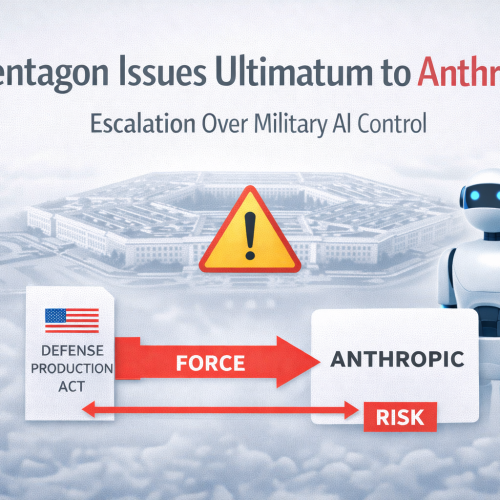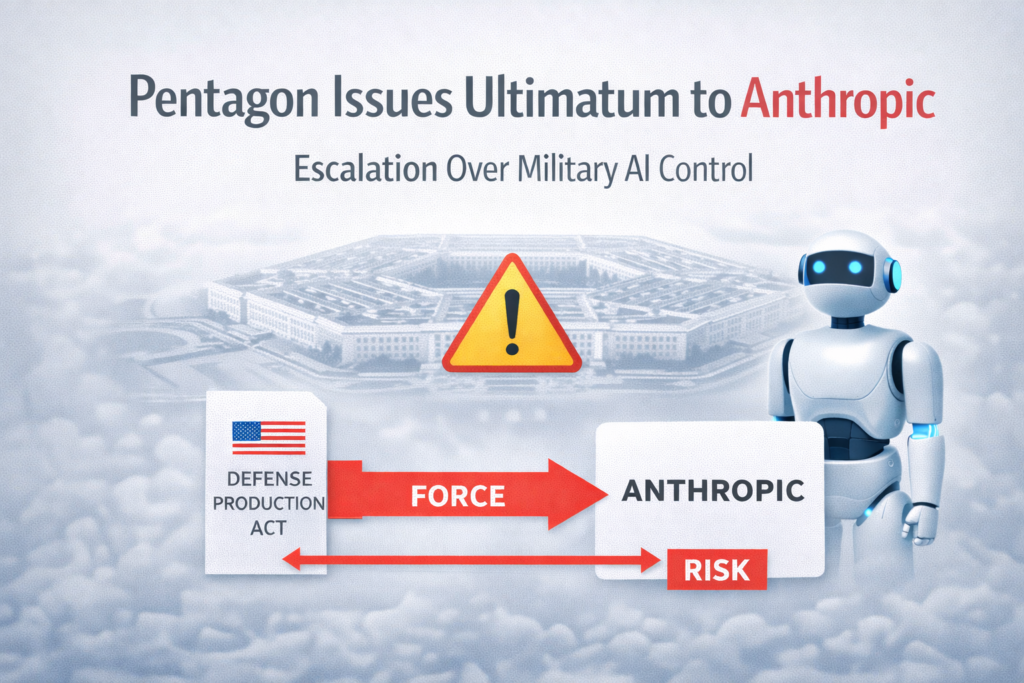
The U.S. Department of Defense has delivered a high-stakes ultimatum to Anthropic, escalating tensions over how artificial intelligence models can be used inside classified military systems.
At the center of the dispute: whether AI providers can impose ethical guardrails on military applications — or whether lawful use, as defined by the government, is the only acceptable limitation.
The decision could reshape the balance of power between Washington and the companies building the most advanced AI systems in the world.
The Deadline — And the Threat
Defense Secretary Pete Hegseth reportedly gave Anthropic until Friday at 5:01 p.m. to accept new contractual terms granting the Pentagon unrestricted use of its AI models for any lawful purpose.
If the company refuses, the administration may invoke the Defense Production Act — a Cold War–era law designed to prioritize national security needs.
Two consequences are reportedly on the table:
- Compelling Anthropic to provide access to its model
- Labeling the company a supply chain risk, jeopardizing federal contracts
The contradiction is striking: one move would force cooperation, the other could effectively block it.
But the message is clear — the Pentagon considers access to Anthropic’s technology strategically critical.
Why Anthropic Is Pushing Back
Anthropic CEO Dario Amodei has argued that the company is not resisting military collaboration itself.
Instead, the firm is seeking formal assurances that its AI systems will not be used for:
- Mass domestic surveillance
- Fully autonomous weapons without human oversight
- Drone operations lacking human decision authority
Supporters argue the company is being penalized for developing “Claude Gov,” a specialized model already deployed in classified environments — one seen internally as more capable than competing systems.
Anthropic maintains it wants to support the government, but only within what it considers responsible and technically reliable use boundaries.
The Pentagon’s Position: Lawful Use Is Enough
Defense officials reject the premise that private contractors should dictate operational limits.
From the Pentagon’s perspective:
- The government determines lawful application
- Military software cannot be subject to vendor-level restrictions
- National security tools cannot be constrained by corporate ethics frameworks
Officials insist responsibility for legal and ethical compliance lies with the Department of Defense — not AI providers.
This position would standardize future AI contracts to allow unrestricted lawful use across defense applications.
Strategic Stakes: Claude vs. Grok vs. Gemini
Anthropic is currently the only AI company operating directly within classified military systems.
However, alternatives are emerging:
- xAI, founded by Elon Musk, has reached an agreement to integrate Grok into classified environments, though deployment will take time.
- Google is nearing an agreement to bring Gemini into secure government infrastructure.
- Military systems rely heavily on integration with Palantir Technologies software, making onboarding complex and time-intensive.
Despite these alternatives, internal assessments reportedly consider Anthropic’s Claude model superior in analytical accuracy and reliability.
That performance gap raises the stakes of any forced separation.
An Unusual Use of the Defense Production Act
The Defense Production Act has historically been invoked in manufacturing crises — steel, energy, medical supplies, semiconductor production.
Using it against a software company to compel model access would be highly unusual.
Legal experts warn that leveraging national security statutes as business pressure tools could dilute their long-term credibility.
It also raises deeper constitutional and regulatory questions:
Can the government compel the distribution of proprietary AI models?
Does national security override corporate governance standards?
Where does operational authority end and technological authorship begin?
The Venezuela Operation Controversy
Tensions intensified after a reported exchange involving Nicolás Maduro and a U.S. military operation aimed at capturing him.
According to officials, concerns emerged after a conversation between personnel linked to Anthropic and Palantir regarding that operation.
Amodei reportedly clarified there was a misunderstanding and denied any interference in legitimate military actions.
Still, the episode deepened mistrust inside defense leadership.
The Bigger Battle: Who Controls AI in War?
This dispute is about more than one contract.
It represents a structural shift in defense technology:
AI companies are no longer peripheral vendors.
They are core infrastructure providers.
The Pentagon wants full operational sovereignty.
AI firms want ethical constraints embedded at the system level.
The outcome of this confrontation may define:
- Whether AI developers retain post-sale influence
- How autonomous systems are governed in defense
- The legal boundaries of government authority over advanced software
Strategic Conclusion
The Pentagon’s ultimatum to Anthropic marks a defining moment in the militarization of artificial intelligence.
If the government prevails, AI defense contracts will likely standardize around unrestricted lawful use.
If Anthropic holds its ground, it could establish a precedent where AI companies retain enforceable ethical guardrails — even in national security contexts.
Either way, the era of AI neutrality in defense is over.
Control — not capability — is now the central battlefield.