A world without work.
A society where robots meet every human need.
An economy where money becomes irrelevant.
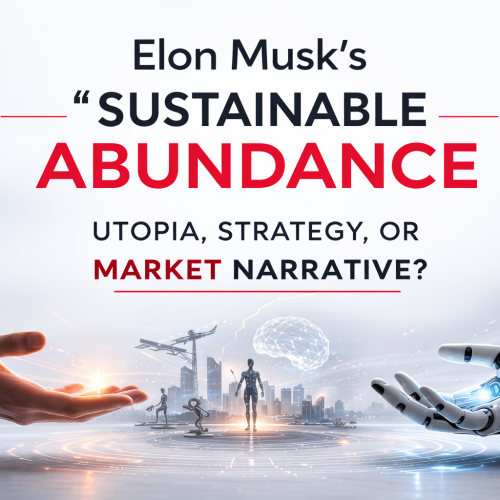
That is the future Elon Musk has been describing under a new guiding principle: “Sustainable Abundance.”
In recent months, the concept has evolved from a passing phrase into a strategic pillar across Musk’s ecosystem — from Tesla’s humanoid robots to SpaceX’s orbital data centers and xAI’s artificial intelligence ambitions.
But is this a realistic technological horizon? A philosophical shift? Or a powerful market narrative designed to reframe the future of capitalism?
Let’s break it down.
What Is “Sustainable Abundance”?
At its core, sustainable abundance describes a post-scarcity society — one in which automation and AI eliminate the need for human labor.
According to Musk:
- Robots will handle physical production.
- AI will solve complex human challenges.
- Goods and services will become nearly limitless.
- People will no longer need traditional jobs.
- Retirement savings may become irrelevant.
- Even poverty could disappear.
At Tesla’s shareholder meeting, Musk described it as:
“Sustainable abundance via A.I. and robotics — that’s the future we’re headed for.”
The vision is bold — and radically optimistic.
A Shift From AI Alarmism to Techno-Optimism
A decade ago, Musk warned that unchecked AI could destroy humanity.
Today, he presents AI and robotics as civilization’s ultimate liberation mechanism.
This ideological shift signals something important:
- AI is no longer framed as existential risk.
- It is positioned as existential solution.
- Growth is declared “infinite.”
- Productivity expansion becomes the central economic thesis.
This reframing aligns with a broader wave of techno-optimism seen across Silicon Valley.
How Tesla, SpaceX, and xAI Fit the Vision
The abundance narrative is not just philosophical — it is operational.
Tesla: From Cars to Humanoid Labor
Tesla is investing heavily in Optimus, its humanoid robot project.
The shift signals:
- Less reliance on EV sales.
- Greater focus on robotics as scalable labor.
- A move toward automation platforms rather than vehicles alone.
If robots become widespread, Tesla becomes a labor infrastructure company — not just an automaker.
SpaceX: Infrastructure Beyond Earth
SpaceX has floated concepts including:
- Orbital AI data centers.
- Self-growing Moon bases.
- Mars colonization ecosystems.
In Musk’s framing, abundance requires energy, computation, and space-based expansion.
xAI: Intelligence at Scale
Musk’s AI venture, xAI, is positioned as a system capable of solving most — if not all — human problems.
In theory:
AI + Robotics + Energy + Space = Post-Scarcity Civilization.
It’s a vertically integrated abundance stack.
The Economic Tension: Who Owns the Capital?
Critics argue the theory leaves fundamental economic questions unanswered.
If humans no longer work:
- Who earns income?
- Who collects taxes?
- Who distributes wealth?
- Who owns the robots?
Economists warn that removing labor income without restructuring capital ownership could:
- Collapse consumer demand.
- Concentrate power.
- Create dependency on tech oligopolies.
- Deepen wealth inequality.
As one economist put it:
If production expands but ownership remains concentrated, abundance could resemble dystopia — not utopia.
Historical Echoes
Musk did not invent abundance.
Similar ideas appeared in:
- Karl Marx’s post-capitalist projections.
- John Maynard Keynes’ 15-hour workweek essay (1930).
- Modern venture capital manifestos promoting techno-optimism.
- Contemporary political debates about productivity expansion.
The difference?
Musk ties abundance directly to private corporate infrastructure rather than public redistribution frameworks.
The Practical Reality: Are We Close?
Today’s limitations are significant:
- Tesla’s Optimus robots show limited real-world deployment.
- Space-based AI data centers remain conceptual.
- AI systems still require human oversight.
- Global inequality remains deeply structural.
Abundance is currently narrative — not operational reality.
Strategic Repositioning or Genuine Mission?
The timing is notable.
Tesla faces:
- Slowing EV growth.
- Increasing competition.
- Market pressure to diversify.
Reframing the company as a robotics and AI infrastructure giant expands:
- Total addressable market.
- Investor imagination.
- Long-term valuation narratives.
Abundance becomes more than ideology — it becomes positioning.
The Political Dimension
If labor disappears, governments lose tax bases.
If robots dominate production, regulation becomes critical.
If AI scales infinitely, governance must scale alongside it.
Without policy evolution, abundance could:
- Destabilize democratic systems.
- Shift economic power toward capital owners.
- Create new forms of technological feudalism.
Conclusion: Visionary Horizon or Economic Mirage?
Elon Musk’s “Sustainable Abundance” is one of the boldest narratives in modern tech.
It promises:
- Unlimited production.
- Liberation from work.
- End of poverty.
- Radical human leisure.
But it leaves unanswered:
- How wealth will be distributed.
- How power will be balanced.
- How markets will function.
- How society transitions from labor to automation.
Abundance may be technologically plausible in fragments.
But socially? Economically? Politically?
That remains the real challenge.
The future may indeed be automated.
Whether it becomes abundant for all — or controlled by a few — depends on decisions being made right now.