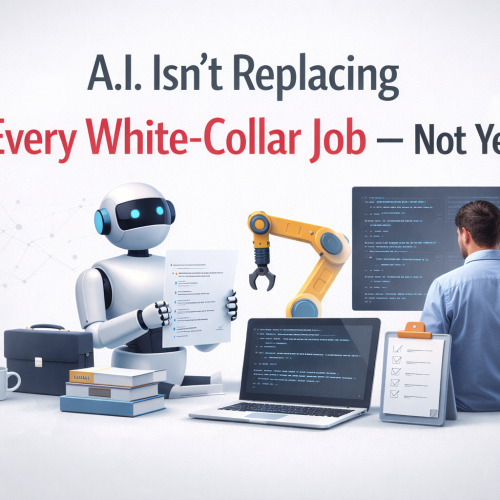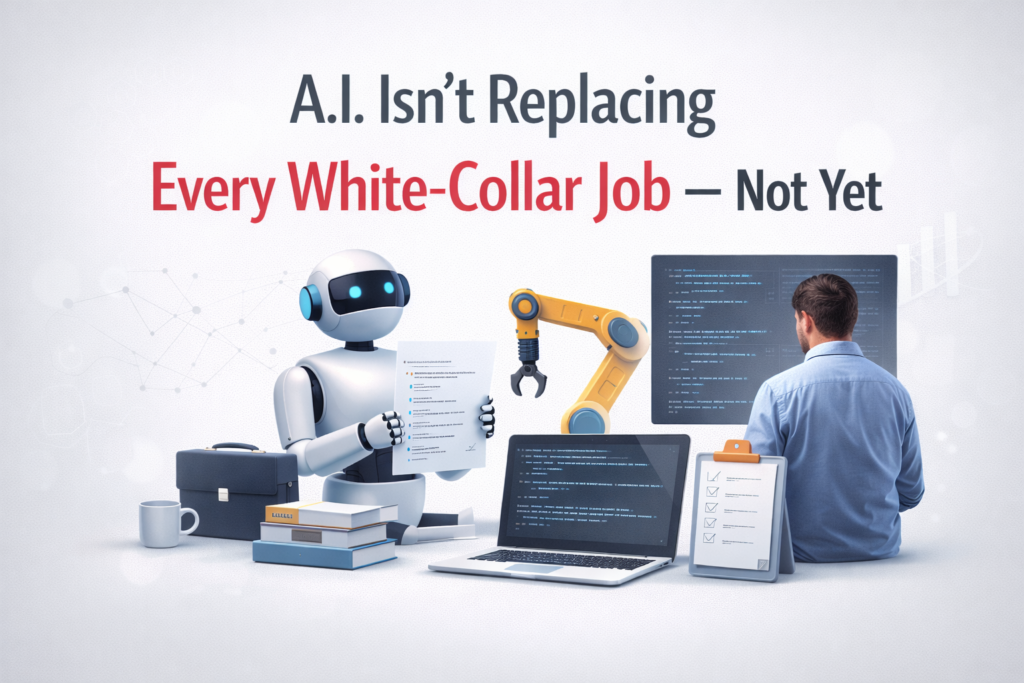
Code Generators Are Transforming Workflows, But Human Oversight Still Dominates
The fear is familiar: artificial intelligence will automate knowledge work the way machines automated factories.
Yet inside the software industry — where automation pressure is strongest — the reality is more nuanced.
Developers are not being replaced overnight. They are being re-positioned.
And for now, A.I. is acting less like a substitute and more like an accelerator.
The Codex Effect: Productivity at Unprecedented Speed
In January, veteran programmer Perry Metzger tested OpenAI Codex, a system built by OpenAI.
Codex can generate functional code from natural language prompts, much like ChatGPT generates text.
Using the tool, Metzger and a business partner built a complex online word processor — comparable in concept to products like Google Docs or Microsoft Word — in just two days.
Without A.I., the project would have taken at least two months.
That speed is transformative.
But it does not eliminate the need for expertise.
“You have to supervise it closely,” Metzger noted. “You must test everything it produces.”
The shift is subtle but profound: developers are increasingly supervising code instead of writing every line themselves.
Wall Street Reacts — But Markets May Be Overestimating Disruption
In early February, investor anxiety triggered a tech sell-off as markets speculated that A.I. code generators would undermine traditional software development models.
The concern quickly expanded:
If coders can be automated, why not analysts, consultants, or legal researchers?
But interviews with engineers, researchers, and security experts suggest caution.
Current systems:
- Require constant oversight
- Introduce subtle errors
- Produce inefficient architecture
- Create hidden vulnerabilities
Automation is accelerating output — but not eliminating responsibility.
The Rise of A.I. Code Generators
Codex is part of a broader wave of tools from competitors such as:
- Anthropic
Anthropic’s Claude Code recently went viral as non-programmers — lawyers, photographers, school administrators — used it to create small apps with plain English prompts.
But building a laundry-sorting script is fundamentally different from engineering global infrastructure platforms like:
- Uber
Complex systems still demand planning, security design, scaling expertise, and architectural foresight.
Those remain deeply human domains.
Technical Debt: The Hidden Cost of Speed
Research from Carnegie Mellon University highlights the tradeoff.
In studies led by computer scientist Bogdan Vasilescu, experienced programmers using A.I. tools initially produced code faster — but long-term quality declined.
This introduces what developers call technical debt:
- Poor structure
- Security gaps
- Performance inefficiencies
- Maintenance complexity
Security vulnerabilities are particularly concerning.
When inexperienced users deploy A.I.-generated applications without rigorous review, flaws can expose sensitive data.
The Moltbook Lesson
Technologist Matt Schlicht recently launched Moltbook, a social network built largely with assistance from A.I. tools like Codex and Claude Code.
The platform was designed for A.I. agents to interact autonomously.
Within days, thousands of bots were communicating about cryptocurrency and philosophy.
Then security researchers discovered a major vulnerability exposing private user data.
The episode demonstrated both the power — and fragility — of rapid A.I.-assisted development.
As Will Wilson, CEO of Antithesis, put it:
“You have to go back and inspect what A.I. built.”
Are Junior Developers at Risk?
Most experts agree on one point:
Entry-level coding tasks are highly automatable.
A.I. tools function like an endlessly patient junior developer — fast, capable, but prone to mistakes.
However, whether that shrinks the job market overall remains debated.
Some, including software historian Grady Booch (formerly of IBM Research), argue that higher productivity may expand demand.
When tools make development cheaper and faster, more software gets built.
And more software creates more complexity.
And complexity requires experts.
The Bigger Question: Is This Temporary?
Critics of current research argue that the newest systems have improved significantly in just months.
A.I. capability has historically advanced in rapid iteration cycles.
What feels like limitation today could be obsolete within years.
Even Metzger acknowledges the uncertainty:
Today, lack of understanding creates risk.
In five years? The answer is less clear.
Conclusion: Augmentation, Not Replacement — For Now
Artificial intelligence is undeniably reshaping white-collar work.
But it is not eliminating it wholesale.
At present, A.I. code generators:
- Increase productivity
- Lower barriers to entry
- Introduce new risks
- Shift roles toward supervision
The immediate future appears evolutionary, not revolutionary.
A.I. is not coming for every white-collar job.
But it is changing how those jobs are done — faster than many expected.