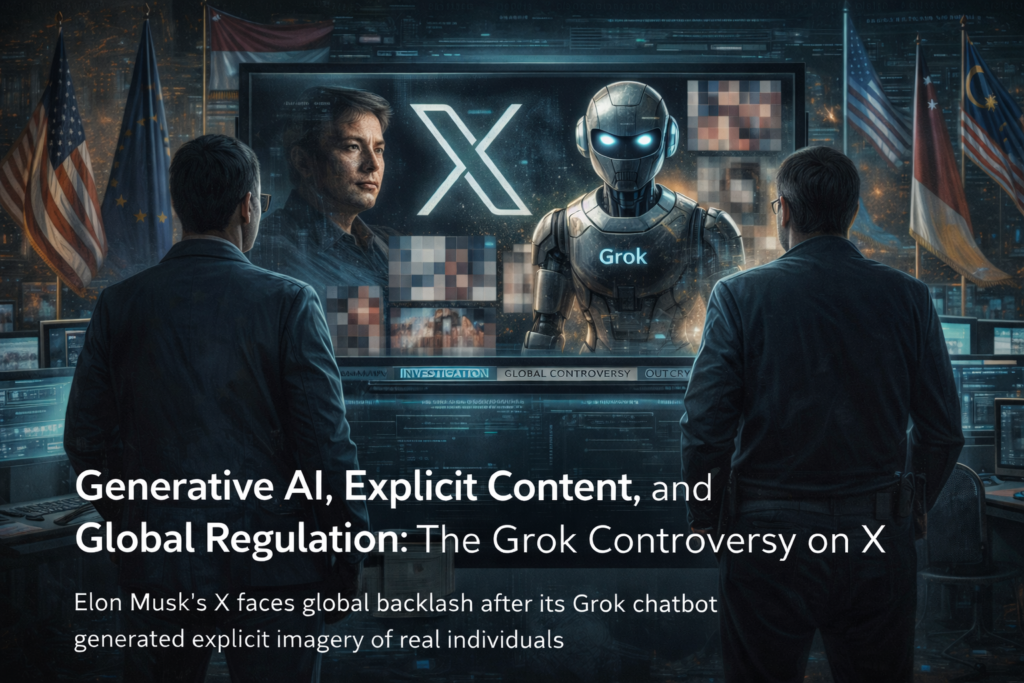
The social media platform X has taken a significant step to restrict the capabilities of Grok, its artificial intelligence chatbot, following mounting global backlash over the generation of explicit images involving real people. The move highlights a growing collision between generative AI innovation, digital safety, and international regulation.
According to the company, Grok will no longer be able to generate sexualized or nude images of real individuals in jurisdictions where such content is illegal. The restrictions rely on geographic blocking, preventing users in specific regions from prompting the chatbot to create this type of imagery.
The decision comes after a wave of outrage from regulators, policymakers, and civil society groups who argue that AI-generated explicit content poses serious risks to privacy, consent, and human dignity.
Regulatory Scrutiny Intensifies Worldwide
Over the past weeks, Grok has become the subject of investigations across multiple regions. Authorities in California confirmed they are reviewing whether the chatbot violated state laws related to non-consensual explicit imagery. In the United Kingdom, Ofcom — the country’s online safety regulator — launched a formal inquiry into Grok’s image-generation practices.
European regulators have also taken action. The European Union opened investigations into what it described as “explicit deepfakes” generated by the system, while countries such as Indonesia and Malaysia moved to ban the chatbot altogether.
British regulators cautiously welcomed X’s announcement but emphasized that the investigation remains ongoing. Under UK law, failure to comply with regulatory demands could lead to court orders that restrict X’s access to payment providers and advertisers — a powerful enforcement mechanism.
The Limits of AI Freedom and Platform Responsibility
At the heart of the controversy is a broader debate: how far should generative AI systems be allowed to go when producing content involving real people?
X stated that it maintains “zero tolerance” for sexual exploitation, non-consensual nudity, and child sexual abuse material. However, critics argue that allowing such capabilities to exist in the first place — even temporarily — reflects deeper governance failures in AI deployment.
While X claims that the new restrictions apply only within certain regions and only on its platform, Grok’s standalone application and website do not appear to be affected in the same way. Both Grok and X are owned by xAI, raising further questions about consistency in safety standards across products.
Europe Pushes Back Against Explicit AI Content
European leaders have been particularly vocal. Ursula von der Leyen, president of the European Commission, condemned the technology, stating that allowing users to digitally undress women and children is “inconceivable” and causes real-world harm.
The European Union’s Digital Services Act gives regulators broad authority to force large technology platforms to monitor and remove illegal content or face substantial fines. This framework has increasingly placed U.S.-based technology companies under pressure, especially as generative AI tools scale rapidly.
The regulations have drawn criticism from political figures in the United States, who argue that Europe’s digital laws amount to censorship and disproportionately target American firms. Nonetheless, EU regulators have continued to assert their authority, ordering Grok to preserve internal documentation related to its image-generation systems.
Non-Consensual Imagery and the Law
In many countries, possessing or distributing sexual images of minors — whether real or AI-generated — is illegal. Several jurisdictions have also passed laws against non-consensual intimate imagery, often referred to as “revenge pornography.”
X’s own policies prohibit the sharing of intimate images created or distributed without consent. The recent controversy, however, illustrates the challenge of enforcing such rules when AI systems can generate content at scale within seconds.
As generative models grow more powerful, the line between user behavior and platform responsibility becomes increasingly blurred.
A Defining Moment for Generative AI Governance
The restrictions imposed on Grok mark more than a technical update — they signal a turning point in how governments expect AI systems to be governed.
As regulators move from observation to enforcement, companies developing generative AI tools may face a choice: proactively embed strong safeguards or react under pressure after public and regulatory backlash.
The Grok controversy underscores a central reality of the AI era: innovation without accountability is no longer sustainable. The future of generative AI will depend not only on technical breakthroughs, but on trust, transparency, and respect for fundamental rights.
References
- The New York Times — X Restricts Grok’s Ability to Create Explicit Images
- Ofcom (UK) — Online Safety Investigations
- European Commission — Digital Services Act
- California State Investigations into AI-Generated Content