The Hidden Reason Technology Investments Don’t Deliver Results
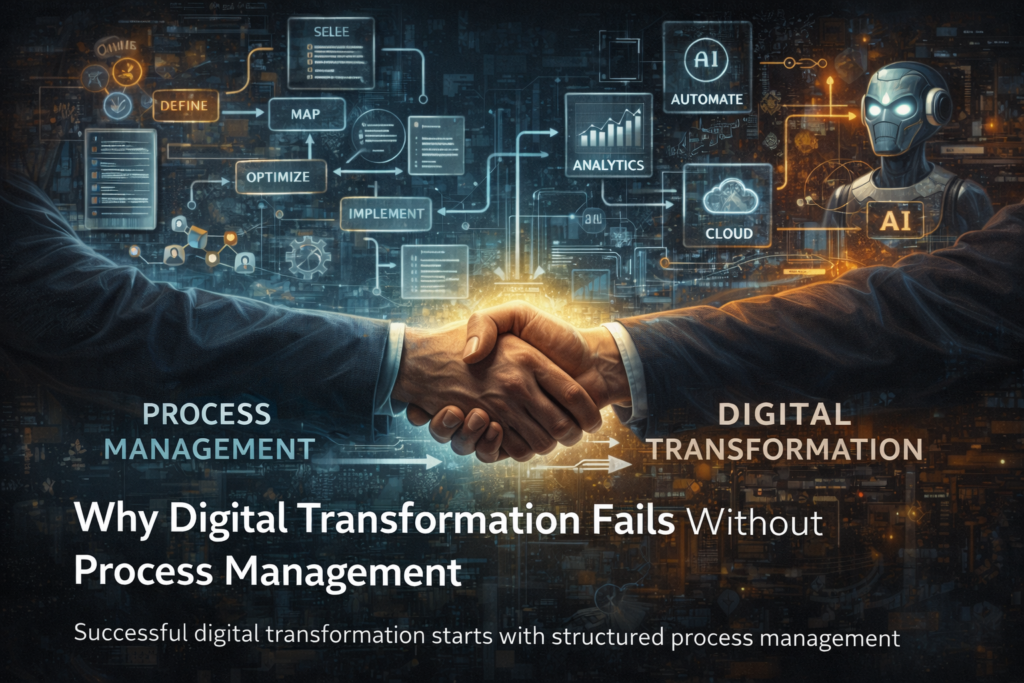
When Digital Transformation Becomes Digital Frustration
Over the past decade, companies across industries have invested heavily in digital transformation. New ERPs, CRMs, automation platforms, AI tools, and analytics dashboards promise efficiency, scalability, and competitive advantage.
Yet, despite these investments, a recurring pattern emerges:
projects exceed budgets, adoption remains low, and results fall short of expectations.
The problem is rarely technology.
The real issue lies beneath the surface — the absence of structured process management.
Digital transformation fails when organizations attempt to automate chaos instead of fixing it.
The Real Problem: Automating Broken Processes
Many companies believe that technology will fix inefficiencies. In reality, technology only amplifies what already exists.
- Inefficient processes become faster inefficiencies
- Poorly defined workflows become harder to manage
- Misaligned teams become more disconnected
Without clear processes, digital tools turn into expensive layers of complexity rather than solutions.
This is why so many transformation initiatives stall shortly after implementation.
Why Process Management Is the Foundation of Digital Success
Process management is not bureaucracy. It is operational clarity.
At its core, it answers critical questions:
- How does work actually flow through the organization?
- Where are the decision points?
- Who owns each step?
- What causes delays, rework, or friction?
When processes are mapped, measured, and optimized before digitalization, technology becomes an enabler — not a crutch.
What Big Tech Gets Right (And Most Companies Miss)
Big Tech companies are often admired for their technology stacks, but their true advantage lies elsewhere.
Their success is built on:
- Clearly defined processes
- Standardized workflows
- Strong ownership and accountability
- Continuous optimization cycles
Technology supports these processes — it does not replace them.
This discipline allows Big Tech to scale globally without losing efficiency, consistency, or control.
The Cost of Ignoring Process Management
Failing to address processes before digital transformation leads to:
- Low system adoption
- Employee frustration
- Operational bottlenecks
- Poor customer experience
- Missed strategic objectives
More importantly, it creates a false narrative that “digital transformation doesn’t work” — when in reality, it was never implemented correctly.
A Better Approach: Process First, Technology Second
Successful digital transformation follows a clear sequence:
- Diagnose operational pain points
- Map and redesign critical processes
- Align teams and responsibilities
- Then apply technology to scale and optimize
This approach reduces risk, increases adoption, and delivers measurable business outcomes.
How Goat Helps Companies Transform the Right Way
At Goat, digital transformation starts with understanding how work actually happens.
We help organizations:
- Identify operational blind spots
- Design efficient, scalable processes
- Align strategy, execution, and customer journey
- Apply technology only where it truly adds value
The result is not just transformation — it is sustainable performance.
Technology Is Powerful — When Processes Are Ready
Digital tools are essential in today’s business landscape. But without strong process management, they become costly experiments.
True transformation happens when organizations stop chasing tools and start fixing foundations.
Because processes don’t slow innovation — they enable it.