Microsoft is making it clear: artificial intelligence is no longer an experiment — it is the engine of its next growth cycle.
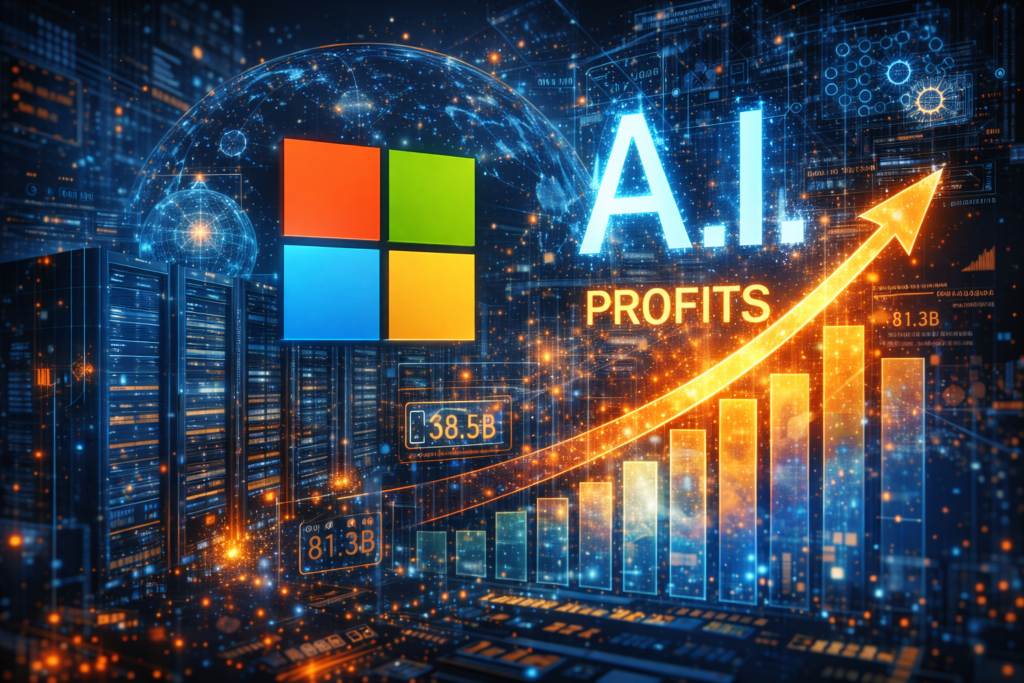
In its most recent quarterly earnings report, the company revealed a striking combination of aggressive investment and soaring profitability. Revenue reached $81.3 billion, a 17% increase year over year, while profits jumped 60%, totaling $38.5 billion. Even as its share price dipped in after-hours trading, the message from Microsoft’s leadership was unmistakable: the company is betting big on A.I., and it plans to keep doing so.
At the center of this strategy is infrastructure.
Billions Flowing Into Data Centers
Microsoft reported $37.5 billion in capital expenditures in the quarter, up approximately 65% compared to the same period last year. Most of that spending is being directed toward expanding data center capacity to support artificial intelligence workloads — from cloud services to large-scale model training.
The company acknowledged that demand for A.I. computing power continues to exceed supply and expects these constraints to persist through 2026. To address this, Microsoft plans to increase its total A.I. capacity by more than 80% over the next two years, a move that signals how central A.I. has become to its long-term roadmap.
Azure as a Barometer of A.I. Momentum
Microsoft’s Azure cloud business remains a key indicator of how well its A.I. strategy is translating into real-world adoption. Azure revenue grew 39% year over year, slightly exceeding Wall Street expectations and reinforcing the idea that enterprises are rapidly migrating A.I. workloads to Microsoft’s ecosystem.
Satya Nadella, Microsoft’s chief executive, framed this moment as just the beginning. According to him, Microsoft’s A.I. business has already grown larger than some of the company’s historic core franchises — despite still being in the early phases of what he described as “A.I. diffusion.”
The OpenAI Connection and Strategic Realignment
Microsoft’s A.I. expansion remains closely linked to its relationship with OpenAI, the creator of ChatGPT. In October, OpenAI announced plans to transition to a for-profit corporate structure, a move that reshaped its partnership with Microsoft.
Under the revised arrangement, Microsoft is expected to hold an estimated $135 billion stake in OpenAI while gaining broad access to its technology. In return, OpenAI committed to purchasing $250 billion in computing power from Microsoft, effectively locking in Azure as a foundational layer for its future growth.
This mutual dependency highlights how infrastructure, models and capital are becoming inseparable in the race for A.I. leadership.
Short-Term Market Reaction, Long-Term Bet
Despite the strong financial results, Microsoft’s shares fell more than 5% in after-hours trading. Investors appeared cautious about the scale of spending required to sustain the company’s A.I. ambitions, particularly as margins face pressure from massive infrastructure investments.
Still, Microsoft’s leadership seems unfazed. The company is positioning itself not just as a software provider, but as a core platform for the global A.I. economy — from enterprise applications to foundational computing power.
Why This Matters
Microsoft’s results underscore a broader shift across the tech industry: artificial intelligence is no longer a feature layered onto existing products. It is reshaping capital allocation, infrastructure planning and competitive strategy at the highest level.
For businesses, investors and policymakers, the message is clear. The next phase of digital transformation will be defined not by who experiments with A.I., but by who can scale it — reliably, securely and at global scale.
Microsoft is betting that it will be one of those companies.