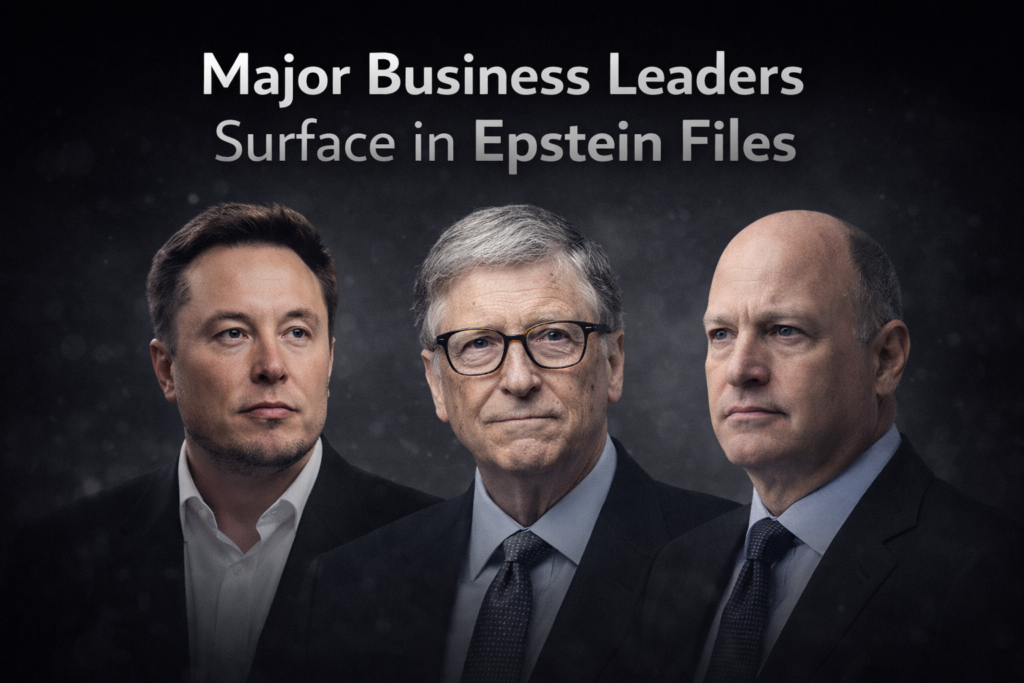
The Justice Department’s release of more than three million pages of documents related to Jeffrey Epstein has revealed the breadth of his connections across the worlds of business, technology, finance and politics. While many of the names appearing in the files are among the most influential figures of the modern era, the documents themselves vary widely in substance — from casual emails and secondhand references to disputed claims and unverified assertions.
What has emerged so far is not a definitive account of wrongdoing by those named, but rather a detailed map of Epstein’s extensive network and his persistent efforts to maintain relationships with powerful individuals long after public scrutiny intensified.
A Wide Net of High-Profile Names
Speculation over who would appear in the Epstein files had circulated for months. When the documents were finally released, they confirmed that Epstein maintained contact — direct or indirect — with a remarkable number of prominent executives.
Among the most notable figures referenced are Bill Gates, Elon Musk and Howard Lutnick, each appearing in different contexts and under very different circumstances.
Bill Gates: Disputed Claims and Private Correspondence
The files include notes and emails drafted by Epstein in 2013 that reference Bill Gates, the Microsoft co-founder. In those communications, Epstein suggested that Gates had engaged in extramarital affairs and expressed frustration over what he described as a deteriorated friendship.
A spokesperson for Gates categorically denied the claims, calling them “absolutely absurd and completely false.” No documents released so far indicate any illegal activity by Gates, nor do they show direct evidence supporting Epstein’s assertions.
Elon Musk: Emails That Complicate Public Denials
Elon Musk has long stated that he distanced himself from Epstein and refused invitations to visit his private island. However, newly released emails show multiple exchanges between the two men.
In one message from 2012, Musk asked Epstein, “What day/night will be the wildest party on your island,” a remark that suggests at least curiosity about visiting. Musk addressed the emails publicly over the weekend, stating that he was aware that some correspondence could be misinterpreted and potentially used to damage his reputation.
The documents do not establish that Musk ever visited Epstein’s island or engaged in misconduct, but they do contradict earlier portrayals of a complete lack of contact.
Howard Lutnick: Planned Visits and Conflicting Accounts
Howard Lutnick, now the U.S. commerce secretary, also appears in the files. Documents suggest that he planned to visit Epstein’s island in 2012, despite previously saying he severed ties with Epstein around 2005.
One message forwarded from an Epstein assistant read simply, “Nice seeing you,” implying that the visit may have occurred. Lutnick told The New York Times that he spent “zero time” with Epstein, underscoring the conflicting narratives that run throughout the document release.
Additional Business Figures Named
Other prominent executives and professionals referenced in the files include:
- Marc Rowan, co-founder of Apollo Global Management, who exchanged emails with Epstein over financial matters. Apollo stated that Rowan had no business or personal relationship with Epstein.
- Brad Karp, chairman of the law firm Paul Weiss, who allegedly asked Epstein for assistance securing a job for his son in the film industry. The firm said it never represented Epstein.
- Sergey Brin, Google co-founder, and Steve Tisch, co-owner of the New York Giants, who appear in communications containing vulgar discussions.
The documents also reference Kevin Warsh, President Trump’s nominee for Federal Reserve chair, adding to the broad scope of Epstein’s reach.
Context Matters More Than Mentions
Crucially, the presence of a name in the Epstein files does not imply criminal conduct. Many references are based on emails Epstein sent or received, notes he drafted himself, or materials that reflect his attempts to associate with powerful individuals.
In several cases, the documents appear to contradict public denials of contact, but they stop short of providing evidence of illegal behavior. Investigators, journalists and legal experts caution that the files should be read as a record of Epstein’s social and professional ambitions — not as a list of culpability.
A Window Into Power and Proximity
The release of the Epstein files has renewed debate about accountability, influence and the gray areas where power and access intersect. While the documents do not rewrite the legal outcomes of the Epstein case, they offer an unusually detailed look at how one individual embedded himself among the global elite — and how those connections continue to raise uncomfortable questions years after his death.
As more files are examined, scrutiny is likely to remain intense, not because every name signals wrongdoing, but because the documents expose how proximity to power can persist long after reputations are publicly disavowed.