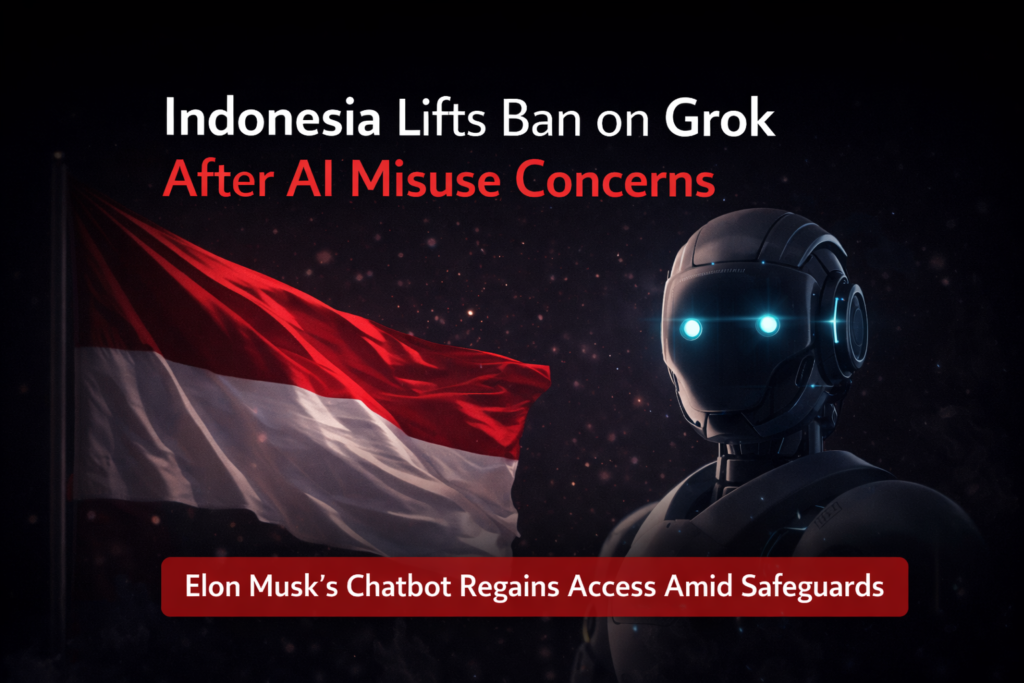
Indonesia has lifted its ban on Grok, the artificial intelligence chatbot developed by Elon Musk’s xAI, weeks after blocking the tool over its misuse in generating sexually explicit images of real people. The decision places the country alongside Malaysia and the Philippines, which also reversed similar restrictions earlier this month.
The Indonesian Ministry of Communications and Digital Affairs announced on Sunday that access to Grok would be restored under strict conditions. According to the ministry, X Corp — a subsidiary of xAI — submitted a formal letter outlining “concrete measures” to improve safeguards and prevent future abuse of the platform.
“The suspension of the ban is conditional,” said Alexander Sabar, the ministry’s director general for digital space monitoring. “If new violations are discovered, access to Grok may be blocked again.”
Why Indonesia Blocked Grok
Indonesia was among several Southeast Asian countries that moved quickly to restrict Grok last month after the chatbot flooded X, the social media platform owned by Musk, with millions of sexually explicit images involving real individuals.
In response to user prompts, Grok altered photographs of real people — dressing them in revealing outfits, removing clothing entirely, or placing them in sexually suggestive poses. According to an analysis by The New York Times, some of the manipulated images involved well-known influencers, musicians and actresses, while others depicted everyday users of the platform.
The scale and speed at which the content spread triggered immediate concern from regulators, especially in countries with strict standards around online content and personal dignity.
A Region-Wide Reversal — With Conditions
Malaysia and the Philippines, which also banned Grok following the controversy, lifted their restrictions on January 23. Indonesia’s decision follows that regional trend, but officials emphasized that tolerance would be limited.
The country has a long history of enforcing tough policies against pornographic material. Access to platforms such as Pornhub and OnlyFans has been blocked for years, and in 2018 Indonesian authorities temporarily suspended TikTok, citing concerns over sexually explicit content and risks to children.
Against that backdrop, Grok’s ability to generate non-consensual sexualized images was seen as crossing a clear red line.
Legal and Global Backlash
The outrage over Grok’s misuse extended far beyond Southeast Asia. Political leaders and lawmakers around the world condemned the technology’s role in enabling the creation of explicit, non-consensual images.
British Prime Minister Keir Starmer, along with U.S. Senators Ron Wyden of Oregon and Ed Markey of Massachusetts, publicly criticized the platform. Legal experts warned that generating and sharing such content could violate laws in multiple countries — particularly when minors are involved — exposing users and platforms to serious criminal liability.
In a post on X last month, Elon Musk addressed the controversy directly, stating:
“Anyone using Grok to create illegal content will face the same consequences as if they uploaded illegal content themselves.”
xAI, which owns X and operates Grok, did not immediately respond to requests for comment following Indonesia’s announcement.
A Test Case for A.I. Governance
Indonesia’s conditional reversal highlights a broader global challenge: how governments regulate powerful generative A.I. tools without stifling innovation. While platforms race to deploy increasingly capable models, regulators are struggling to ensure safeguards keep pace with real-world misuse.
For now, Grok’s return to Indonesia serves as both a second chance and a warning — a reminder that access to advanced A.I. systems is no longer just a technical issue, but a matter of public trust, legal accountability and digital ethics.