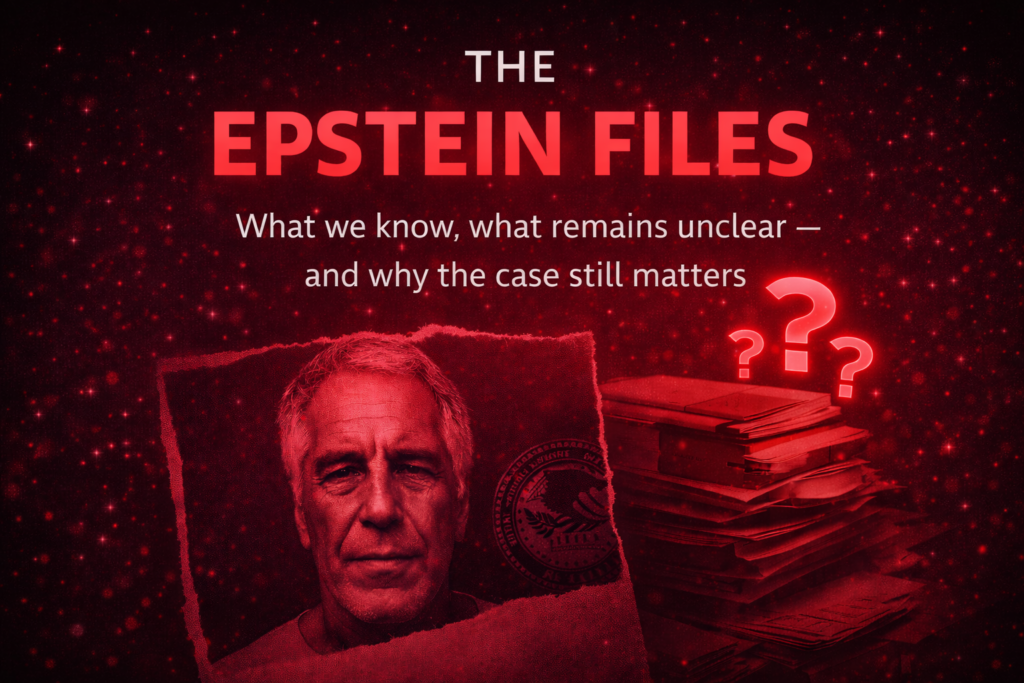
The name Jeffrey Epstein has crossed borders, governments, and elite circles for nearly two decades. Even after his death in 2019, the scandal surrounding the convicted sex offender continues to raise uncomfortable questions — and offer few definitive answers.
The recent release of millions of official documents, known collectively as the Epstein Files, has reignited public scrutiny. More than uncovering shocking new names, the files expose how power, wealth, and silence intertwined for years around a man who was already a known criminal.
So what exactly are the Epstein Files — and why does this case remain so politically and socially sensitive?
What Are the Epstein Files?
The Epstein Files refer to a vast collection of documents gathered by prosecutors and investigators since 2005, when Epstein first came under investigation in Florida over allegations of abusing underage girls.
Since November, the U.S. government has been legally required to release these records. To date, more than three million pages have been made public, drawn from criminal investigations conducted between 2006 and 2019.
The material includes:
- Financial records and banking documents
- Emails, text messages, and personal correspondence
- Photos, videos, and internal files
- Information related to victims, associates, and clients
Not all of the documents directly concern sex trafficking. Many provide insight into Epstein’s financial dealings and the vast social network he cultivated over decades.
Did the Latest Files Change the Story?
So far, the newly released material does not fundamentally alter the core understanding of the Epstein case. What it does provide is context — and a clearer picture of who continued to associate with Epstein even after he became a registered sex offender in 2008.
The files reveal:
- How normalized Epstein’s presence was among elite circles
- The willingness of powerful figures to overlook widely known allegations
- How young, vulnerable women were treated as background figures — or worse
Rather than delivering a single explosive revelation, the files reinforce a broader pattern of indifference, complicity, and silence.
A Truly Global Scandal
While most individuals named in the files are American, the Epstein story is unmistakably international.
Documents reference figures such as:
- Andrew Mountbatten-Windsor, the former British prince
- Peter Mandelson, former U.K. ambassador to the U.S.
- Ehud Barak, former prime minister of Israel
- Members of the Norwegian royal family
Many of the young women involved were recruited from Eastern Europe and Russia, highlighting the global reach of Epstein’s operations.
Why Did So Many Powerful People Associate With Epstein?
One of the most persistent questions remains: why did so many influential individuals choose to stay close to Epstein — even after his crimes were publicly known?
The answer appears less personal and more structural.
Money creates access.
Access creates prestige.
Prestige attracts more power.
Epstein positioned himself as a connector within elite society. Associating with him meant access to influential networks — and many were willing to ignore the moral cost.
The Most Disturbing Dimension
Perhaps the most unsettling aspect of the files is what they reveal about how victims were viewed.
Many of the young women came from unstable backgrounds, poverty, or prior abuse. In the documents, they often appear marginalized — treated as disposable, invisible, or simply part of the environment.
In that sense, the Epstein case is not only about sexual crimes. It is about power, class, and the dehumanization of vulnerable people.
The Political Fallout
For some, the Epstein story has increasingly become tied to Donald Trump. His social connection to Epstein was well known long before the 2016 election, but the issue gained renewed attention when Trump promised full transparency regarding the case.
Instead, the release of largely already-public material — promoted as a major disclosure — fueled suspicion among critics and supporters alike.
Still, investigators caution against framing the Epstein Files as a single political scandal. The larger story is systemic, involving global elites across industries and ideologies.
Why the Epstein Files Still Matter
Years after Epstein’s death, the files remain relevant because they illustrate how systems of power can protect abusers for decades.
They offer no clean resolution — only a clearer reflection of how wealth, influence, and silence can override accountability.
And that may be the most troubling revelation of all.