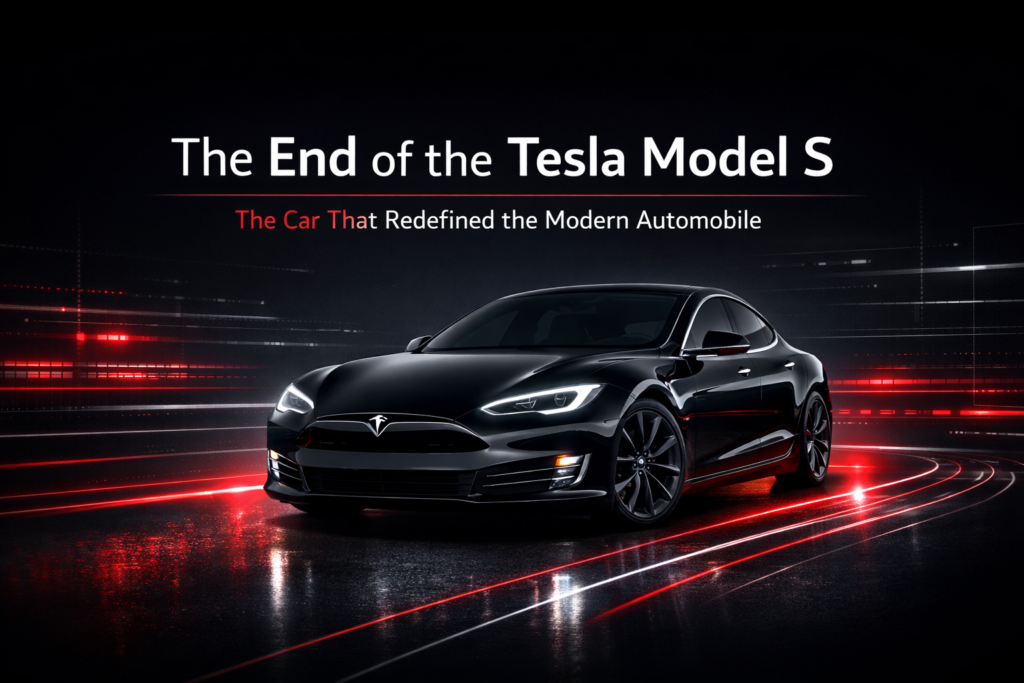
When Elon Musk announced that Tesla would discontinue the Model S and Model X, the news marked far more than the end of two vehicle lines. It signaled the closing of a defining chapter in automotive history. Launched in 2012, the Tesla Model S was not just an electric car — it fundamentally reshaped how the world thinks about performance, software, and what a modern vehicle can be.
At the time of its debut, electric vehicles were largely seen as niche products. They were practical, environmentally friendly, and, for the most part, uninspiring. Designed primarily to meet emissions regulations, they appealed to a small group of early adopters rather than the broader market. The Model S shattered that perception.
From the moment drivers stepped inside, it was clear this car was different. The massive 17-inch touchscreen dominating the dashboard was unprecedented, signaling a radical shift toward a software-first approach. The Model S wasn’t defined by mechanical complexity, but by code. Over-the-air updates allowed Tesla to improve braking, extend driving range, and even introduce entirely new features without the car ever visiting a dealership.
Performance was another revelation. Instant torque delivered acceleration previously reserved for high-end sports cars, all while remaining nearly silent. Combined with an electric range of roughly 200 miles at launch — and up to 300 miles in higher-end versions — the Model S outperformed every electric rival on the road. In contrast, the best-selling EV in the U.S. at the time, the Nissan Leaf, offered barely 80 miles of range.
The impact of the Model S extended far beyond Tesla’s sales figures. It redefined the luxury segment and forced legacy automakers like BMW, Mercedes-Benz, Audi, and Lexus to rethink their entire product strategies. Software suddenly became as important as horsepower. Today, nearly every major automaker is racing to build “software-defined vehicles,” a concept Tesla introduced to the mainstream.
Tesla also accelerated the industry’s push toward autonomy. With the introduction of Autopilot just two years after launch, the Model S ignited a global race to develop advanced driver-assistance systems and self-driving technologies. Cameras, sensors, artificial intelligence, and constant software updates became central pillars of vehicle development.
The success of the Model S laid the foundation for Tesla’s broader lineup. It made the Model 3 and Model Y possible — smaller, more affordable vehicles that now account for the vast majority of Tesla’s sales. By 2022, Tesla surpassed BMW, Mercedes-Benz, and Lexus to become the best-selling luxury car brand in the United States, an outcome few could have imagined a decade earlier.
Even as sales of the Model S slowed in recent years, its legacy remained unquestioned. The car helped turn Tesla from a niche automaker into the most valuable car company in the world. More importantly, it forced the entire automotive industry to invest hundreds of billions of dollars into electric vehicles and digital platforms.
Production may be ending, but the Model S leaves behind a permanent mark. Much like Ford’s Model T changed how cars were made, the Tesla Model S changed what cars are. After it, the industry could never go back.