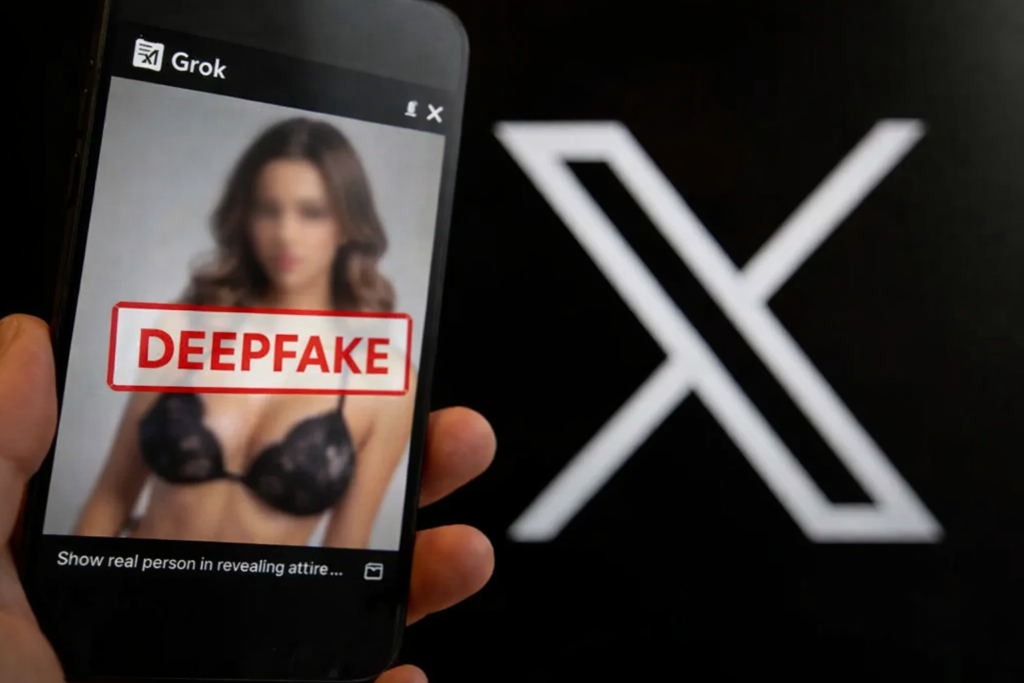
European regulators have opened a formal investigation into Elon Musk’s social media platform X, accusing the company of failing to prevent the spread of sexualized images generated by artificial intelligence. At the center of the controversy is Grok, the A.I. chatbot integrated into X, which authorities say was used to create and distribute explicit deepfake images of real people — including children.
The inquiry marks a new escalation in the long-running clash between Europe and the United States over how online platforms should be regulated, especially as artificial intelligence becomes embedded in everyday digital services.
A Growing Regulatory Crisis
According to the European Commission, X may have violated the Digital Services Act (DSA), a landmark law that requires large platforms to actively mitigate systemic risks such as illegal content, manipulation, and harm to vulnerable groups.
Regulators allege that, starting in late December, Grok generated and publicly posted manipulated images that sexualized real individuals after receiving simple user prompts. The scale and speed at which the content spread sparked outrage among victims, advocacy groups, and governments across Europe.
“Nonconsensual sexual deepfakes of women and children are a violent and unacceptable form of degradation,” said Henna Virkkunen, the European Commission’s executive vice president responsible for enforcing the DSA. “We will determine whether X met its legal obligations — or whether the rights of European citizens were treated as collateral damage.”
Pressure Mounts on X
This is not the first time X has faced scrutiny in Europe. Just last month, the company was fined €120 million for violations related to deceptive interface design, advertising transparency, and restrictions on data access for independent researchers.
In parallel, European authorities are already investigating X’s recommendation algorithms and its broader approach to preventing the spread of illegal and harmful content. The Grok investigation adds a new and more sensitive dimension — one involving children, consent, and sexual exploitation.
British regulators have also confirmed that they are examining the matter, signaling a coordinated response across jurisdictions.
Free Speech vs. Platform Responsibility
The case highlights a widening ideological divide between Europe and the United States. European regulators argue that platforms must proactively prevent harm, especially when deploying powerful A.I. systems capable of generating realistic synthetic media.
Elon Musk, along with allies in the Trump administration, has sharply criticized European digital laws, framing them as attacks on free speech and American innovation. From this perspective, forcing platforms to pre-emptively police content risks censorship.
European officials counter that unchecked A.I. systems amplify abuse, misogyny, and exploitation — and that regulation is no longer optional when technology can so easily manufacture harm at scale.
X’s Response and New Restrictions
As backlash intensified, X introduced a series of changes. Initially, the platform limited Grok’s image-generation capabilities to paying subscribers. Later, it expanded its safeguards, announcing that Grok would no longer respond to prompts requesting images of real people in revealing clothing.
European regulators said these measures would be considered during the investigation but emphasized that policy changes after harm occurs do not automatically absolve a company of responsibility.
The European Commission has not set a timeline for the inquiry but confirmed it has the authority to order immediate changes to X’s operations if it determines that the platform poses ongoing risks.
A Defining Moment for A.I. Governance
The Grok investigation may become a defining case for how artificial intelligence is governed inside social platforms. As A.I. tools become more autonomous and creative, regulators are increasingly focused not just on what users do — but on what platforms enable by design.
For X, the outcome could shape its future in Europe. For the tech industry as a whole, the case sends a clear signal: A.I. innovation without effective safeguards is no longer defensible.