Elon Musk’s ambitions have just moved beyond Earth — quite literally.
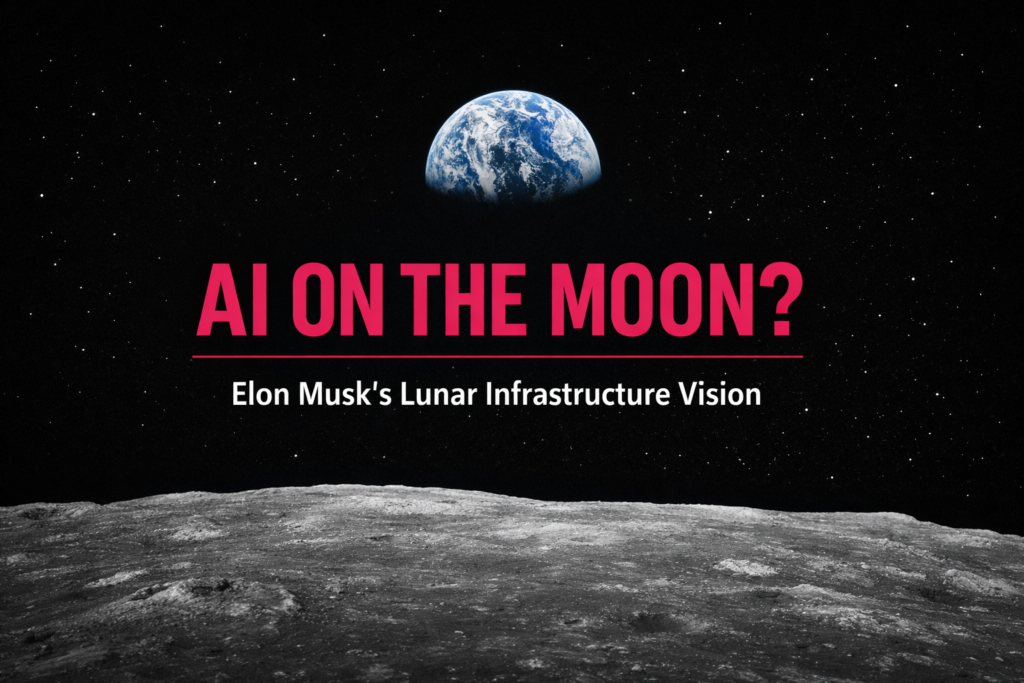
During an internal meeting with employees at xAI, his artificial intelligence company, Musk outlined a vision that blends science fiction, orbital infrastructure, and competitive AI strategy: building a factory on the Moon to manufacture AI satellites and using a massive “space catapult” to launch them into orbit.
It may sound cinematic. But coming from the person who normalized reusable rockets and reshaped the private space industry, it’s difficult to dismiss.
The Vision: A Lunar Factory to Power Artificial Intelligence
According to reports from the meeting, Musk stated that xAI would need to go to the Moon to gain a real competitive advantage in the AI race.
The proposed lunar installation would:
- Manufacture AI-dedicated satellites
- Provide massive computational power off-Earth
- Reduce reliance on terrestrial infrastructure
At the center of the project would be a “mass driver” — an electromagnetic launch system capable of propelling payloads into space far more efficiently than traditional rocket launches.
The strategic logic is straightforward:
Whoever controls infrastructure at unprecedented computational scale can reshape the global AI hierarchy.
And Musk wants that infrastructure beyond Earth.
From Earth to Orbit: Space-Based Data Centers
Just a week earlier, Musk announced the merger of xAI with SpaceX. The stated reason? To facilitate the creation of AI data centers in outer space.
This integration is critical.
Today, the primary bottlenecks in AI development are not algorithms — but:
- Energy supply
- Cooling systems
- Hardware scalability
- Physical constraints of terrestrial data centers
Moving computation to orbit — or even to the Moon — could:
- Leverage near-constant solar energy
- Reduce cooling costs
- Scale without geographic limitations
- Establish orbital technological sovereignty
If this sounds distant, remember: SpaceX has already industrialized space launches.
The Moon as a Stepping Stone — Not the Final Destination
Historically, Musk has emphasized Mars as SpaceX’s ultimate goal. Since founding the company in 2002, he has positioned Mars colonization as its core mission.
But in recent months, the Moon has taken center stage.
During the meeting, Musk outlined a phased plan:
- Build a self-sustaining city on the Moon
- Use the Moon as a launch base for Mars
- Expand toward exploration of other star systems
The Moon, therefore, would function as an operational laboratory — closer, more viable, and strategically practical.
For AI, that means permanent space-based infrastructure.
Strategy or Narrative?
Musk is known for bold predictions — some realized, others significantly delayed.
In 2016, for example, he stated that SpaceX would send cargo to Mars by 2018. That mission has yet to occur.
The inevitable question is:
Are we looking at a concrete roadmap — or a visionary narrative designed to mobilize talent and investors?
From a strategic standpoint, even if a lunar AI factory takes decades, the narrative already serves immediate purposes:
- Attract elite engineers
- Reinforce technological leadership perception
- Position xAI as a company thinking beyond planetary limits
In technology markets, perception is power.
The Role of X (Formerly Twitter)
During the same meeting, Musk also discussed the evolution of X.
According to him, the platform now has around 600 million monthly active users — a figure not independently verified.
Upcoming additions include:
- X Money (a financial services feature)
- A standalone messaging app
- Expanded daily engagement initiatives
The broader vision appears to converge toward an integrated ecosystem:
AI + Space + Social Platform + Financial Infrastructure.
A vertically integrated technology empire — potentially self-sustaining.
What Is Really at Stake
If the lunar AI infrastructure becomes reality, the implications go far beyond science fiction.
We are talking about:
- Computational sovereignty
- Private orbital infrastructure
- The global race for super-scalable AI
- Indirect space militarization via computing power
The company that controls large-scale off-Earth computation could define the next era of the digital economy.
And once again, Musk aims to be first.
Conclusion
Perhaps the lunar AI factory will never materialize.
Perhaps it will take 20 years.
Or perhaps it will begin sooner than expected as a smaller experimental step.
But one thing is clear: Musk is not just competing on better AI models. He is competing on absolute infrastructure.
And when the race shifts from software dominance to physical control of space, we are entering a new technological era.
The question is no longer whether the Moon will host computation.
The question is: who will get there first?