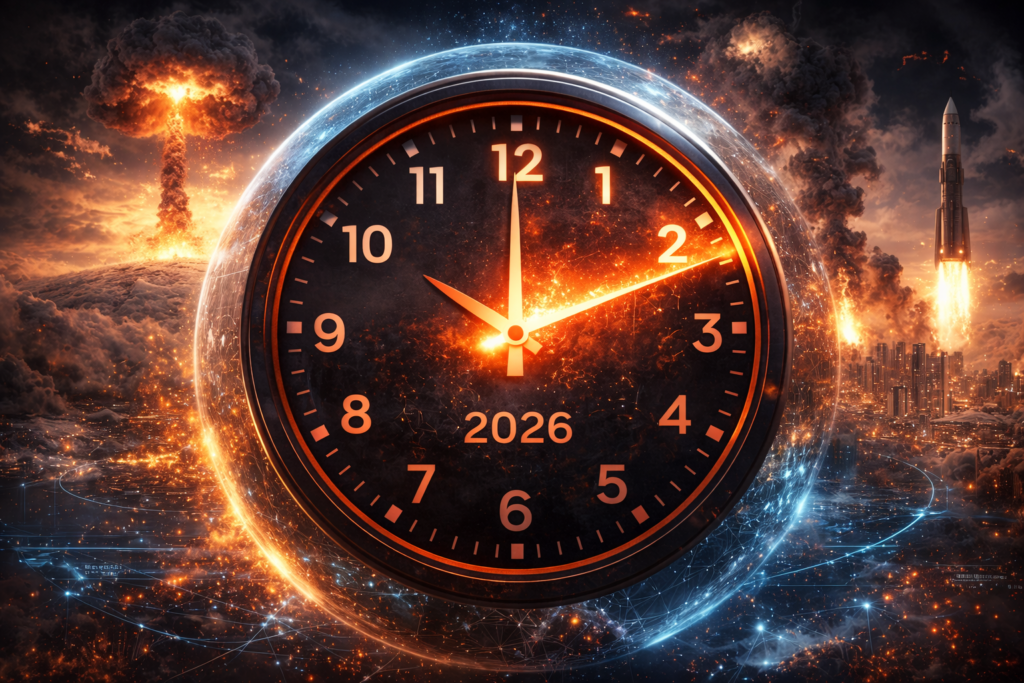
The Doomsday Clock — a symbolic measure of how close humanity is to self-destruction — has moved closer to midnight than at any point in its nearly 80-year history. As of January 27, 2026, scientists set the clock at 85 seconds to midnight, reflecting a convergence of global threats that are intensifying faster than the world’s ability to respond.
Created in 1947 by the Bulletin of the Atomic Scientists, the clock was initially designed to warn about nuclear catastrophe. Today, it captures a far broader spectrum of existential risks — from climate collapse and artificial intelligence to geopolitical instability and the erosion of democratic norms.
Why the Clock Moved Forward in 2026
According to the scientists behind the clock, the decision to advance it by four seconds was driven by a dangerous accumulation of unresolved crises. The key issue is not just the presence of these threats, but the decline in global cooperation needed to manage them.
As Alexandra Bell, president and CEO of the Bulletin, stated, catastrophic risks are increasing while collective action is weakening. The clock is no longer a warning about a single danger — it is a signal that multiple systems meant to protect civilization are failing simultaneously.
Nuclear Risks at Their Highest Since the Cold War
Nuclear tensions remain the most immediate existential threat. In 2025 alone, several developments raised alarm among security experts:
The war between Russia and Ukraine entered its fourth year, accompanied by tests of nuclear-capable weapons.
India and Pakistan experienced renewed military tensions, underscoring the fragility of deterrence between nuclear rivals.
The United States and Israel carried out strikes on Iranian nuclear facilities.
North Korea expanded its nuclear arsenal and missile capabilities while strengthening ties with Russia.
China continued to increase its stockpile of nuclear warheads.
Perhaps most concerning, the last major nuclear arms control agreement between the United States and Russia is approaching expiration. If allowed to lapse, it would mark the end of more than six decades of formal nuclear restraint between the world’s largest nuclear powers.
Climate Change: A Crisis Accelerating Beyond Control
Climate change remains a slow-moving but relentless force pushing the clock closer to midnight. Scientists noted that 2025 recorded the third-highest global average temperature on record. Extreme weather events became more deadly and more frequent, including catastrophic flooding in the Democratic Republic of Congo and heat waves across Europe that killed tens of thousands.
At the same time, major governments rolled back environmental protections. In the United States, climate and pollution regulations were dismantled, weakening both mitigation and adaptation efforts. These reversals, scientists warn, are locking in irreversible damage to ecosystems and human health.
Disruptive Technologies and the Rise of Artificial Intelligence
Emerging technologies are amplifying existing risks rather than neutralizing them. Artificial intelligence has advanced rapidly, raising concerns about its use in autonomous weapons, cyber warfare and large-scale disinformation campaigns.
The Bulletin also highlighted warnings from scientists about laboratory-created “mirror life” — synthetic biological systems that could theoretically escape containment, disrupt ecosystems and trigger pandemics. Combined with weakened public health infrastructure, these innovations represent a new category of risk: high-impact, low-regulation threats.
Autocracy and the Collapse of Global Cooperation
A central theme behind the 2026 adjustment is the rise of what scientists describe as “nationalistic autocracy.” While not an existential threat on its own, this governance model prioritizes zero-sum competition over cooperation.
The Bulletin cited the leadership styles of the United States, Russia and China as examples of governments increasingly favoring unilateral action. This mindset, experts argue, undermines global problem-solving precisely when shared solutions are most necessary.
As antinuclear activist Hideo Asano warned, nationalism and unilateralism are eroding universal values and mutual benefit — principles essential for addressing global existential risks.
A Warning, Not a Prediction
Critics often dismiss the Doomsday Clock as symbolic or subjective. But its creators emphasize that it is not meant to predict the future. Instead, it is designed to spark urgency.
At its furthest point from catastrophe, in 1991, the clock stood at 17 minutes to midnight, following the end of the Cold War and major arms control agreements. Today’s setting reflects not inevitability, but failure — a failure to act decisively while time still remains.
The clock’s message is clear: the world is not doomed, but it is running out of time.