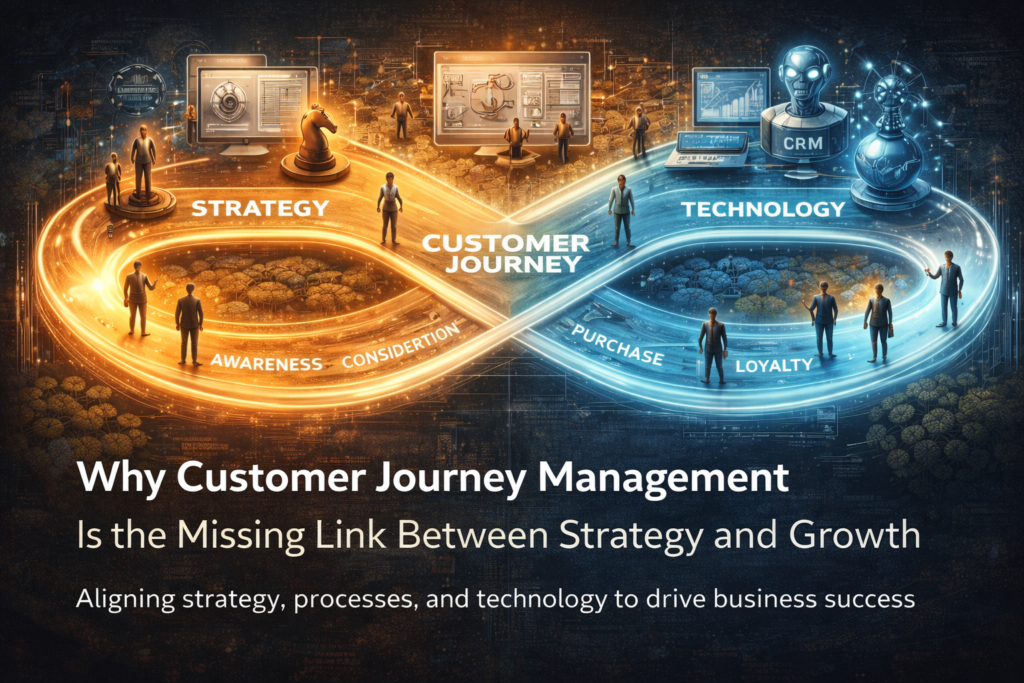
Many companies believe they understand their customers. They invest in marketing tools, CRMs, analytics platforms, and automation software. Yet, despite all this technology, customers still experience friction, confusion, and inconsistency at every interaction point.
The problem is not the lack of data or tools.
The problem is the absence of structured Customer Journey Management.
Customer Journey Management is what transforms disconnected touchpoints into a cohesive, intentional experience — one that aligns customer expectations with internal processes and business objectives.
The Real Problem: Fragmented Experiences
From the customer’s perspective, companies often feel disorganized:
- Sales promises something operations can’t deliver
- Support teams lack full context of previous interactions
- Digital channels don’t reflect offline experiences
- Processes are optimized internally, but not for the customer
Each department works hard — but in isolation. The result is a journey full of gaps, repeated steps, delays, and frustration.
Customers don’t see departments.
They experience one journey.
Customer Journey Management Is Not a Marketing Concept
A common misconception is that customer journey management belongs only to marketing. In reality, it is a cross-functional business discipline.
Effective journey management connects:
- Business strategy
- Internal processes
- Technology and data
- Human decision-making
It maps how customers move across the organization — from first contact to long-term relationship — and aligns internal operations to support that flow consistently.
From Touchpoints to End-to-End Journeys
Managing isolated touchpoints is no longer enough. Modern customers interact across multiple channels, devices, and teams.
Customer Journey Management focuses on:
- Understanding customer intent at each stage
- Identifying friction points and operational bottlenecks
- Designing processes that support the experience, not fight it
- Using technology as an enabler, not a patch
When journeys are designed intentionally, companies reduce effort for both customers and employees.
The Business Impact of Structured Journeys
Organizations that manage customer journeys effectively see measurable results:
- Higher conversion and retention rates
- Reduced operational inefficiencies
- Faster decision-making
- Better alignment between teams
- Stronger brand perception
More importantly, journey management creates clarity. Teams understand why processes exist and how their actions impact the customer experience.
Technology Without Journey Thinking Fails
CRMs, automation platforms, AI tools, and analytics systems are powerful — but only when embedded into a clear journey strategy.
Without journey management:
- CRMs become data silos
- Automation amplifies broken processes
- AI optimizes the wrong outcomes
With journey management:
- Technology supports decision-making
- Data gains context
- Automation enhances human experience
Technology should follow the journey — not define it.
How Goat Approaches Customer Journey Management
At Goat, Customer Journey Management is not a theoretical framework. It is a practical, structured approach that connects:
- Process design
- Customer experience strategy
- Technology applied to business
- Continuous optimization
We help organizations visualize their journeys, redesign internal processes around real customer behavior, and implement technology that drives measurable business outcomes.
The result is not just better experiences — but sustainable growth.
Growth Happens When Journeys Make Sense
Customers don’t abandon companies because of one bad interaction.
They leave because the journey feels broken.
Managing the customer journey means managing the business itself. When journeys are clear, processes aligned, and technology purposeful, growth becomes a natural consequence — not a constant struggle.