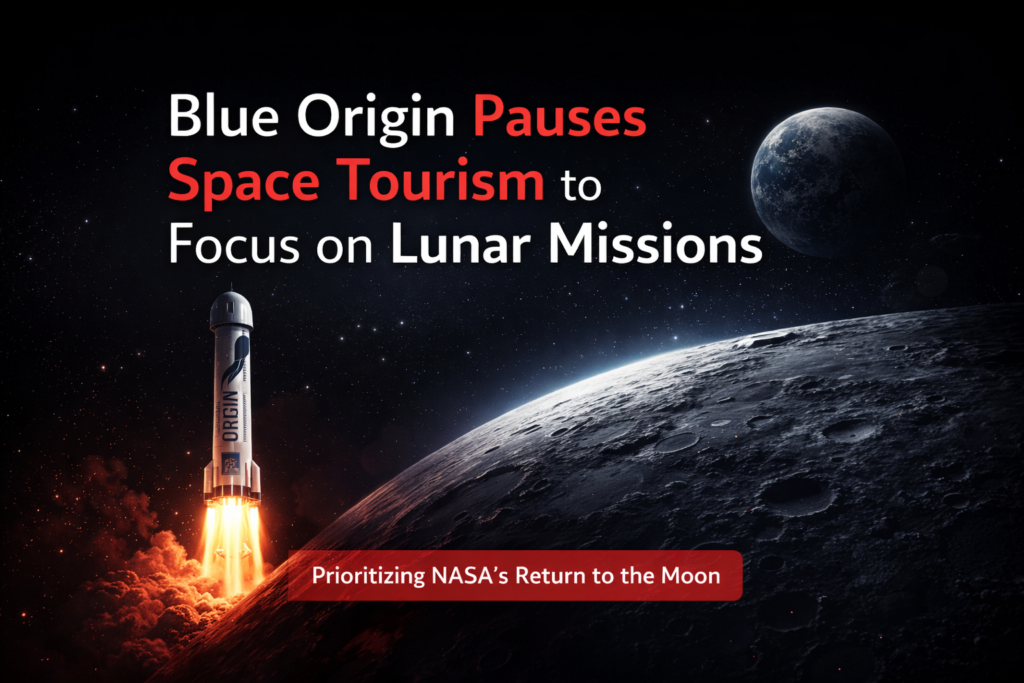
For years, Blue Origin’s New Shepard rocket became a symbol of the emerging space tourism era, carrying celebrities and private citizens alike to the edge of space. Now, that chapter is coming to a pause.
The aerospace company founded by Jeff Bezos announced that it will suspend New Shepard flights for at least two years, shifting its full attention toward supporting NASA’s ambitious plans to return astronauts to the Moon under the Artemis program.
The decision marks a strategic pivot for Blue Origin — one that reflects both the financial realities of space tourism and the growing urgency of government-backed lunar exploration.
From Celebrity Flights to Strategic Pause
New Shepard made headlines in 2021 when Jeff Bezos himself flew aboard its first crewed mission. The suborbital rocket later carried well-known figures such as William Shatner, Michael Strahan and Katy Perry, helping to popularize the idea of civilian spaceflight.
In total, New Shepard flew 38 missions from Blue Origin’s launch site in West Texas, transporting 98 passengers — 92 unique individuals — above the Kármán line, often considered the boundary of outer space. Passengers experienced a few minutes of weightlessness before the capsule returned to Earth under parachutes, while the reusable booster performed a powered vertical landing.
Despite the attention and technological success, the business never scaled as initially envisioned. Launch cadence remained limited, and ticket pricing was never officially disclosed. Even under optimistic assumptions, space tourism revenue remained small compared with Blue Origin’s far larger government contracts.
Why the Moon Matters More Than Tourism
Blue Origin’s pause is driven by priorities far beyond suborbital tourism. The company holds a $3.4 billion NASA contract to develop a lunar lander for the Artemis program, which aims to return humans to the Moon for the first time since Apollo.
Originally, Blue Origin’s lander was scheduled for Artemis V, a mission unlikely to launch before the 2030s. However, delays in SpaceX’s Starship-based lander — planned for Artemis III and IV — prompted NASA to ask both companies to explore ways to accelerate development timelines.
NASA Administrator Jared Isaacman confirmed that the agency is actively pursuing parallel acceleration paths, underscoring how critical lunar landing capabilities have become. Political pressure has also increased, with President Trump publicly pushing for Artemis III to launch before the end of 2028.
In this context, dedicating engineering talent, infrastructure and capital to New Shepard no longer made strategic sense.
A Financial Reality Check for Space Tourism
While New Shepard flights generated valuable experience and publicity, their revenue potential paled in comparison to lunar contracts. Even if every seat had sold for $1 million — a commonly cited estimate — total passenger revenue would still fall under $100 million.
By contrast, NASA’s lunar lander contracts represent long-term funding, technological relevance and strategic positioning in the future of human spaceflight.
Virgin Galactic, Blue Origin’s closest competitor in suborbital tourism, has faced similar challenges. The company halted flights of its operational spaceplane in 2024 to focus on building next-generation vehicles designed for higher flight frequency and increased passenger capacity. Commercial suborbital tourism, it seems, remains a concept ahead of its time.
Technology That Lives On
Despite its pause, New Shepard will not be remembered as a dead end. The rocket served as a critical testbed for reusable propulsion systems and autonomous landing technology.
A derivative of New Shepard’s engine powers the second stage of Blue Origin’s much larger New Glenn rocket. Experience gained from landing New Shepard boosters also contributed to Blue Origin’s successful recovery of a New Glenn booster on a floating barge last year — a major milestone for the company.
In that sense, New Shepard functioned less as a profit engine and more as a technological stepping stone.
The Bigger Picture
Blue Origin’s decision reflects a broader truth about the space industry: government exploration programs, not tourism, continue to drive the most consequential advances.
While space tourism captured public imagination, the return to the Moon carries geopolitical, scientific and technological weight that few private ventures can match. By pausing New Shepard, Blue Origin is signaling that its future lies not in short suborbital rides, but in shaping humanity’s next sustained presence beyond Earth.