Blood Money: Lethal Eden and the Dark Reality of Online Scam Centers
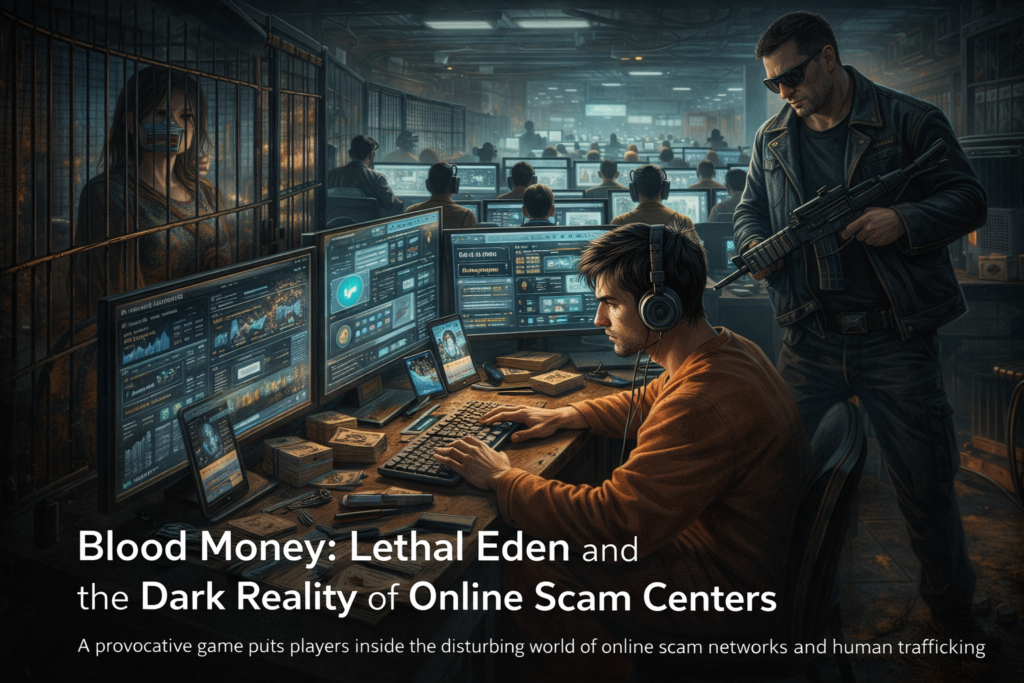
A woman you meet online smiles — then everything goes dark. You wake up inside a cage, surrounded by armed men, before being dragged into a massive office filled with thousands of people working at computers. Your captors offer you a deal: scam innocent victims online, reach a financial target, and earn your freedom.
This is not a crime documentary.
It is the opening sequence of “Blood Money: Lethal Eden,” a newly released video game that is igniting intense debate by placing players inside the brutal reality of online scam centers.
More than entertainment, the game reflects a real and growing global crisis — one involving human trafficking, cybercrime, and billions of dollars stolen from victims worldwide.
A Game Built on Real-World Trauma
Developed by Jade Flame, a Chinese studio based in Sichuan province, Blood Money: Lethal Eden belongs to the full-motion video (FMV) genre, where players make narrative choices that shape the story’s outcome.
Although the game never explicitly names its location, the fictional compound closely resembles real scam facilities operating in Southeast Asia, particularly in Myanmar and Cambodia. Characters speak Mandarin, while the game’s promotional material includes Burmese text — subtle but powerful signals of its inspiration.
These compounds are not fictional.
According to the U.S. Treasury Department, scam networks tied to these facilities have defrauded Americans alone of more than $16.6 billion, making this one of the most profitable forms of organized cybercrime today.
From Fantasy to Social Reality in Gaming
The release of Blood Money highlights a broader shift in the Chinese gaming industry. Over the past two years, developers have increasingly moved away from fantasy and escapism toward stories rooted in social anxiety and cultural reality.
As Allison Yang, founder of Reality Reload, explains, this genre reflects issues players recognize in their own lives. China has become one of the primary targets of scam networks, both financially and socially, with citizens frequently lured into fraudulent job offers or romantic schemes — sometimes ending in forced labor abroad.
In this context, Blood Money functions as a digital mirror, forcing players to confront uncomfortable truths rather than heroic narratives.
Inside the Mechanics of Exploitation
In the game, players must decide whether to:
- Participate in online scams to survive
- Protect fellow captives from punishment
- Obey criminal bosses or face torture
These choices closely resemble real testimonies from survivors of scam centers. Journalists from The New York Times who visited abandoned compounds in Myanmar described:
- Vast office floors filled with computers
- Chinese restaurants and luxury villas for crime bosses
- Evidence of physical abuse and coercion
Critics on the Steam platform have noted that the game includes areas dedicated to fraud operations, prostitution, and punishment, aligning disturbingly well with real-world investigations.
Controversy, Criticism, and Cultural Impact
Despite its powerful premise, Blood Money has received mixed reactions.
Some critics argue that turning human suffering into gameplay risks trivializing trauma. Others see it as a form of interactive journalism, raising awareness among audiences who might otherwise ignore the issue.
Game analyst Victor Fu, writing on Douyin, questioned the game’s commercial success, citing modest production quality and limited appeal at its $8 price point. Yet its impact may lie less in sales and more in conversation.
Governments worldwide are already responding to the real crisis:
- China and South Korea have organized rescue flights for victims
- The U.S. and U.K. have imposed sanctions on individuals linked to scam centers
- Criminal leaders in Myanmar and Cambodia have been extradited
The game enters this global dialogue at a critical moment.
Why This Story Matters Beyond Gaming
Blood Money: Lethal Eden is not just about gaming innovation — it is about how digital experiences can expose systemic crimes.
It challenges players to confront:
- The human cost behind online fraud
- The psychological mechanisms of coercion
- The thin line between victim and perpetrator
In doing so, it demonstrates how interactive media can evolve from entertainment into social commentary, forcing difficult but necessary conversations about technology, crime, and human exploitation.
Why This Game Matters
While Blood Money: Lethal Eden may not become a commercial blockbuster, its cultural impact is significant. It exposes a hidden digital economy built on exploitation and deception — one that affects millions of people across borders.
As governments increase crackdowns and impose sanctions on individuals linked to scam operations, public awareness becomes a critical line of defense. Games like Blood Money challenge audiences to understand that behind every fraudulent message may be a coerced human being.
In a digital world where trust is currency, understanding how online scam centers operate is essential — not just for cybersecurity professionals, but for society as a whole.
References
- Steam Community Reviews — Blood Money: Lethal Eden
- The New York Times — A New Video Game Traps Players in an Online Scam Center
- U.S. Department of the Treasury — Reports on global online fraud losses
- Interpol — Human trafficking and cyber-enabled fraud assessments