Overview
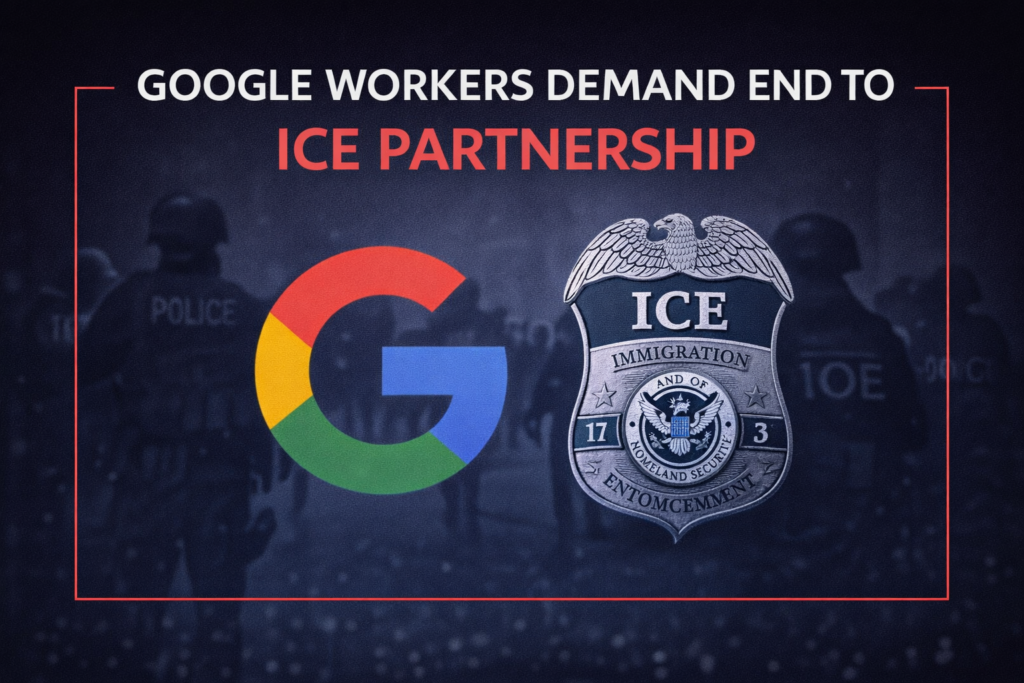
More than 800 Google employees have petitioned company leadership to halt cloud services provided to U.S. immigration agencies, citing ethical concerns over the use of Google technology in enforcement actions linked to violence and militarized raids. The petition marks a renewed wave of employee activism in Silicon Valley and reopens a long-running debate over the role of big tech in government surveillance and law enforcement.
A Renewed Push From Inside Google
In the days following the killing of Alex Pretti by federal immigration agents in Minneapolis, Google’s internal forums filled with messages urging the company to respond. That pressure culminated in a petition signed by more than 800 employees and delivered to management, demanding transparency around how Google’s technology supports immigration enforcement and calling for an end to business relationships with those agencies.
The petition condemns what it describes as “paramilitary-style raids” conducted by immigration authorities and accuses Google of indirectly enabling them through its cloud infrastructure. Employees also asked the company to strengthen on-campus security after reports that Immigration and Customs Enforcement agents attempted to enter Google’s Cambridge, Massachusetts, campus.
Employee Activism Returns to Silicon Valley
The petition signals a resurgence of worker activism at Google after several relatively quiet years. In 2018, Google employees staged mass walkouts over sexual harassment policies and protested the company’s involvement in a Pentagon program that used artificial intelligence to enhance drone strike analysis.
Since then, Google leadership has curtailed internal debate by restricting access to documents, reducing company-wide meetings and taking disciplinary action against protests tied to government contracts. Two years ago, the company fired 28 employees who opposed its cloud computing deal with the Israeli government.
Despite those measures, some employees say the company’s original ethos still resonates.
“They’ve scrubbed the motto, but the values are still there,” said Matthew Tschiegg, a senior cloud engineer who signed the petition, referring to Google’s long-standing informal slogan, “Don’t be evil.”
Tensions With the Trump Administration
The renewed activism comes as Silicon Valley leaders appear increasingly aligned with the Trump administration. Executives and investors from companies such as Apple, Meta, SpaceX and Tesla have publicly supported the president through donations and policy cooperation, fueling perceptions that the tech industry has shifted politically.
The death of Mr. Pretti exposed fractures in that alignment. Several tech leaders publicly criticized immigration enforcement tactics, though Google’s chief executive, Sundar Pichai, has not issued a public statement. Jeff Dean, Google’s chief scientist at DeepMind, wrote on social media that violence tied to immigration enforcement should be universally condemned.
Cloud Contracts and Ethical Questions
The petition was organized by No Tech for Apartheid, a collective of Google and Amazon employees that has previously opposed cloud contracts with government and military entities. It references reporting that Google provides cloud services to Customs and Border Protection and highlights the company’s partnership with Palantir, a data analytics firm whose software has been used to track immigrants.
Google has said that the Department of Homeland Security accesses only commercially available cloud services through customers, including basic storage and computing infrastructure. Employees argue that this distinction does not resolve concerns about how the technology is ultimately used.
“It feels like the company is chasing revenue without fully grappling with the consequences,” Mr. Tschiegg said. “That creates a moral and ethical dilemma.”
A Broader Debate Over Tech Responsibility
The petition asks for a formal question-and-answer session with executives and clarity on whether Google will allow its artificial intelligence systems to be used by immigration authorities. More broadly, it reflects a growing internal debate over whether technology companies should draw firmer lines around government use of their platforms.
As immigration enforcement intensifies and artificial intelligence becomes more deeply embedded in state power, Google’s response may set a precedent not just for its own workforce, but for the broader tech industry grappling with the limits of ethical responsibility.