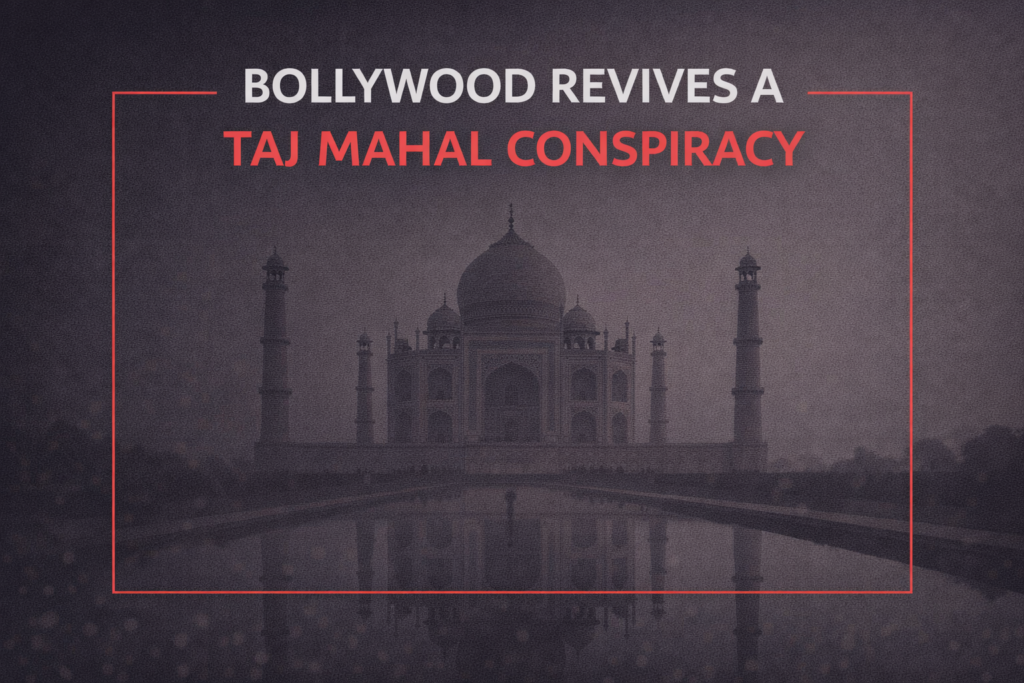
For decades, a fringe theory has clung to the marble walls of the Taj Mahal, insisting that one of the world’s most celebrated monuments is not what history says it is. Long dismissed by scholars as fiction, the idea has found new life — not in academic journals, but in Bollywood.
A recent Indian film has propelled a long-debunked conspiracy theory into the cultural mainstream, turning a monument of shared heritage into a battleground for identity, politics and historical truth.
A Monument, Rewritten
The Taj Mahal, commissioned in the 17th century by the Mughal emperor Shah Jahan as a mausoleum for his wife Mumtaz Mahal, is widely regarded as a masterpiece of Indo-Islamic architecture. Its history is meticulously documented by contemporaneous records, court chronicles and architectural studies.
Yet a persistent theory claims the structure predates the Mughal era and was originally a Hindu palace or temple — a narrative rejected repeatedly by historians, courts and India’s own archaeological authorities.
The evidence offered by proponents has always been speculative: selective carbon dating, misinterpreted architectural symbols, and allegations of “hidden chambers” concealing proof of an alternative past. None have withstood scrutiny.
Still, the theory has endured — and now, cinema has given it a new audience.
From Internet Fringe to Silver Screen
“The Taj Story,” a Bollywood courtroom drama released late last year, frames the conspiracy as a quest for suppressed truth. Marketed as a revelation of “untold history,” the film follows a tour guide who challenges the accepted narrative and seeks judicial validation for his suspicions.
What it ultimately delivers is not new evidence, but renewed attention.
By dramatizing discredited claims, the film elevates them from obscure online forums into popular discourse, blurring the line between fact and fiction for millions of viewers.
Cultural critics have drawn comparisons to Oliver Stone’s JFK — a film that, decades earlier, helped revive conspiracy theories in the United States by presenting speculation in the authoritative language of legal inquiry.
Nationalism, Identity and Selective Memory
The resurgence of Taj Mahal conspiracy theories cannot be separated from India’s current political climate. Since 2014, Hindu nationalist narratives have increasingly shaped public debate, emphasizing historical grievances and reframing the Mughal period as an era of foreign domination.
Within this worldview, Mughal monuments are not symbols of cultural synthesis but reminders of conquest — and thus targets for reinterpretation.
Historians argue that this selective reading erases India’s pluralistic past, replacing complexity with ideological certainty. India’s Muslim population, roughly 200 million people, is often placed at the center of these cultural battles.
Critics warn that popularizing historical revisionism through entertainment risks deepening religious divisions in a country already marked by communal tension.
The Cost of Conspiracies
India’s courts have repeatedly rejected legal challenges seeking to reclassify the Taj Mahal as a Hindu religious site. The Supreme Court has dismissed demands for new investigations, citing a lack of credible evidence.
The danger, historians note, is not legal success but social impact.
In 1992, a similar revisionist movement culminated in the destruction of a mosque in Ayodhya, followed by nationwide violence that killed thousands. That episode remains a cautionary tale of how historical conspiracies can spill into real-world consequences.
The Taj Mahal, protected as a UNESCO World Heritage Site, is unlikely to face physical destruction. But its symbolic role — as a testament to coexistence — is increasingly contested.
Algorithms, Attention and Amplification
Social media has played a crucial role in amplifying the film’s themes. Fact-checkers report a spike in online discussions repeating claims long disproven, fueled by clips, memes and algorithmic reinforcement.
Attempts by India’s Archaeological Survey to debunk the theories — including releasing photos of the so-called “secret chambers” — have sometimes backfired, reinforcing suspicions among believers who interpret transparency as concealment.
Once a conspiracy enters popular culture, experts say, correcting it becomes exponentially harder.
A Test for Historical Truth
The Taj Mahal was never meant to be a political weapon. Its architects blended Islamic design with local artistic traditions, incorporating motifs that reflected the diversity of the subcontinent.
To many historians and guides who work at the site, the monument tells a story not of domination, but of synthesis.
As one veteran guide put it: the Taj Mahal was built to represent everyone — an idea increasingly at odds with a moment that demands simpler, more divisive narratives.
The question now is not whether the conspiracy is true — it is not — but how easily stories, once fictional, can reshape collective memory when amplified by cinema, nationalism and digital platforms.