Artificial intelligence has returned to the center of market anxiety — and this time, the fear is not about hype collapsing, but about success arriving faster than expected.
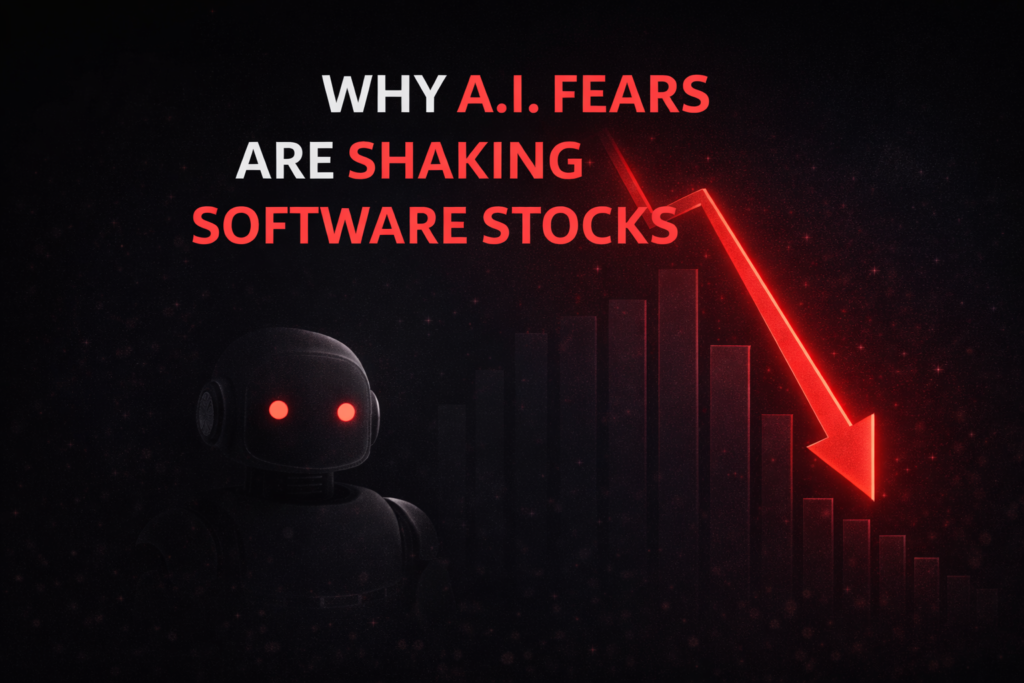
Global software and analytics stocks fell sharply after Wall Street suffered a major sell-off, driven by growing concerns that new A.I.-powered tools could fundamentally disrupt traditional software business models. In just one trading session, software and services companies lost an estimated $300 billion in market value, underscoring how quickly sentiment can shift when technological inflection points appear imminent.
A new wave of disruption
The latest catalyst came from Anthropic, the company behind the Claude chatbot, which recently unveiled advanced automation tools capable of handling legal, marketing and customer-service tasks. For investors, the implications were immediate and unsettling: if businesses can automate these functions internally using A.I., many existing software subscriptions could become redundant.
The market reaction was swift. Shares of Thomson Reuters dropped nearly 16 percent, LegalZoom fell close to 20 percent, and a JPMorgan index tracking U.S. software stocks slid 7 percent. The shockwaves extended beyond the U.S., with Infosys, a major Indian IT outsourcing firm, also seeing its stock fall sharply.
These declines did not emerge in isolation. Even before Anthropic’s announcement, major enterprise software companies such as Salesforce, HubSpot and Atlassian had already lost more than 30 percent of their value over the past year, reflecting mounting unease about long-term demand.
Why investors are nervous
At the heart of the sell-off lies a deeper concern: A.I. is no longer just enhancing software — it may be replacing parts of it.
Startups like Harvey and Legora have already begun pressuring incumbents in legal and professional services. But the entrance of foundational A.I. model developers into these markets raises the stakes. Instead of relying on dozens of specialized software tools, companies may increasingly build custom workflows powered by a handful of A.I. platforms.
According to Toby Ogg, an analyst at JPMorgan Chase, more than 50 institutional investors across the U.S. and Europe reported reducing their exposure to software stocks over the past two weeks alone — a sign that the reassessment is both widespread and accelerating.
The counterargument: A.I. still needs software
Not everyone agrees that traditional software is headed for extinction.
At a recent industry conference, Jensen Huang, the CEO of Nvidia, dismissed the idea that A.I. would replace software outright. “The notion that tools in the software industry are in decline and will be replaced by A.I. is the most illogical thing in the world,” he said.
Huang’s argument is simple: A.I. systems still rely on existing tools rather than reinventing them from scratch. Whether human or artificial, agents need reliable infrastructure to operate. From this perspective, A.I. could increase demand for software, not eliminate it — albeit reshaping how that software is used and priced.
Markets are pricing the future forward
What makes this moment particularly volatile is timing. Financial markets tend to price in expectations 12 to 18 months ahead, meaning investors are already trying to anticipate how A.I. adoption will affect employment, productivity and corporate spending.
The fear is not that jobs or revenues will collapse overnight, but that the direction of travel is becoming clearer — and faster. If companies begin trimming software budgets while reallocating spending toward A.I. platforms, the ripple effects across the tech sector could be profound.
A familiar cycle, with higher stakes
Concerns about technological disruption are nothing new. But unlike previous waves of innovation, A.I. directly targets white-collar knowledge work — a domain long considered relatively insulated from automation.
This helps explain why markets are reacting so strongly. The question is no longer whether A.I. will change how businesses operate, but how much value it will capture — and from whom.
As earnings season continues, investors will be watching closely for signals from companies like Alphabet, particularly around adoption rates of its Gemini A.I. models. Those numbers may offer the clearest indication yet of whether today’s fears are overblown — or merely the first tremors of a much larger shift.