A Historic Deal — With an Asterisk
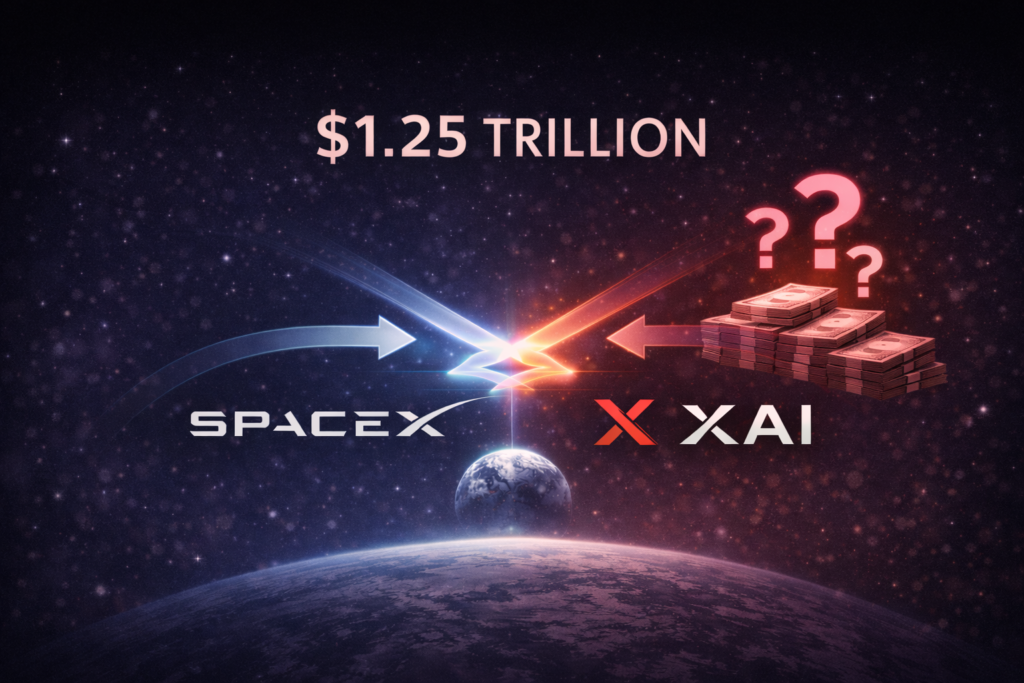
Elon Musk has orchestrated what may be the largest private merger ever: SpaceX’s acquisition of xAI, creating a combined entity valued at approximately $1.25 trillion. The deal is entirely stock-based, involving privately valued shares — a crucial caveat that has drawn both fascination and skepticism across financial markets.
The timing is notable. The merger comes just ahead of a long-anticipated SpaceX IPO, potentially later this year, fundamentally reshaping the company’s narrative for prospective investors.
What the Numbers Say
According to people familiar with the transaction:
- SpaceX valuation: ~$1 trillion, up from roughly $800 billion in December
- xAI valuation: ~$250 billion, slightly above its most recent funding round
- New shares issued: ~$250 billion, significantly diluting existing SpaceX investors
SpaceX, which reportedly generated over $15 billion in revenue and nearly $8 billion in profit last year, is now absorbing an AI startup that has raised more than $42 billion since 2023 — and is estimated to be burning close to $1 billion per month.
Musk’s Vision: AI Data Centers in Space
Musk argues that the merger enables a radical form of vertical integration. In his view, placing AI data centers in orbit could eliminate terrestrial constraints such as land availability and energy limits.
“In the long run, space-based AI is obviously the only way to scale,” Musk wrote in a memo to employees.
The idea is bold — and controversial. Experts point to unresolved challenges, including:
- Cooling systems potentially larger than tennis courts
- Protection from cosmic radiation
- Launch costs that would need to fall by an order of magnitude
While Musk predicts feasibility within two to three years, Google engineers have previously suggested such economics may not arrive until the 2030s.
The Bull Case
Supporters say the deal simplifies Musk’s focus and strengthens SpaceX’s long-term narrative.
Andrew Rocco, a strategist at Zacks Investment Research, described the combined entity as potentially “far more compelling” to investors, arguing that it removes distractions and aligns Musk’s ambitions under a single corporate umbrella.
The merger also offers a financial lifeline to xAI, granting it access to SpaceX’s robust cash flows.
The Bear Case
Skeptics, however, see significant risks.
SpaceX’s investment story was once clean: rockets, satellites, and a dominant satellite internet business. Now, potential IPO investors must grapple with:
- A deeply unprofitable AI division
- Ownership of X, a social media platform frequently at odds with regulators
- Increased regulatory and antitrust scrutiny
There are also long-term competition concerns. If Musk controls space-based data centers, could rival AI companies realistically access that infrastructure?
As one investor reportedly put it: “We understand the logic — but it still makes us pause.”
A More Complicated IPO Story
Ultimately, the merger may strengthen Musk’s empire while complicating SpaceX’s near-term financial narrative.
The bet is clear: that rockets, satellites, AI models, social media, and space-based computing will ultimately reinforce one another — and be worth far more together than apart.
Whether public market investors will agree remains an open question.