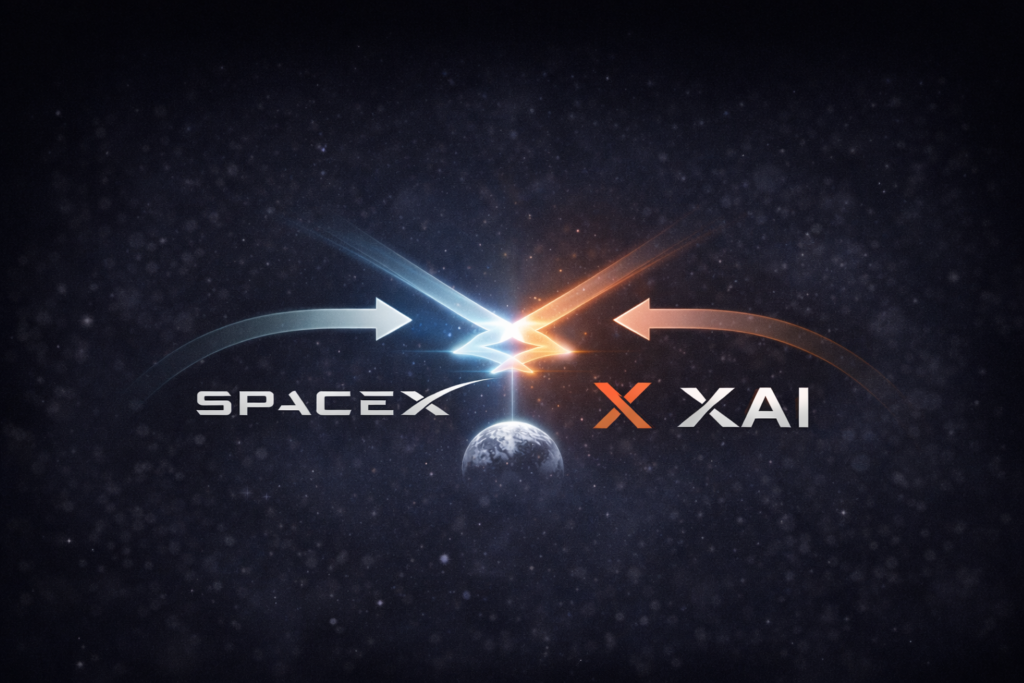
Elon Musk has taken another dramatic step toward consolidating his sprawling business empire. On Monday, SpaceX announced that it had acquired xAI, the artificial intelligence startup controlled by Musk, in a deal that further intertwines his ventures and could create the most valuable private company in the world.
While the precise financial terms were not disclosed, people familiar with the transaction said the combined entity would be valued at more than $1 trillion, placing it well ahead of any other privately held company. The move also gives xAI a crucial financial lifeline as it races to compete with more established AI players.
According to individuals briefed on the plans, the newly combined company could pursue an initial public offering as early as June, with Musk aiming to raise roughly $50 billion. Those plans, however, remain fluid and subject to market conditions.
A Strategic Lifeline for xAI
Founded later than rivals like OpenAI and Anthropic, xAI has spent billions of dollars trying to catch up in the increasingly capital-intensive AI race. By folding the startup into SpaceX, Musk effectively shifts part of that financial burden onto a company that already has deep investor backing and lucrative government contracts.
In an internal memo obtained by The New York Times, Musk framed the acquisition in grand, almost science-fiction terms. He described the merger as creating “the most ambitious and vertically integrated innovation engine on Earth — and beyond,” combining rockets, artificial intelligence, satellite internet, direct-to-device communications and real-time information platforms.
At the center of the deal is Musk’s growing belief that AI computing will eventually move to space. Space-based data centers, he argued, would face fewer land constraints and could tap more directly into solar energy, dramatically reducing the long-term cost of large-scale AI computation.
“My estimate is that within two to three years, the lowest-cost way to generate AI compute will be in space,” Musk wrote to SpaceX and xAI employees.
An Unusual Corporate Bet
The merger underscores how Musk increasingly views his companies not as separate businesses, but as interconnected parts of a single ecosystem. Last year, he merged xAI with X, the social media platform formerly known as Twitter, to consolidate data, computing power and talent. Absorbing xAI into SpaceX is a far more consequential leap.
Still, the logic of combining a rocket manufacturer with an AI chatbot and a social media platform is not obvious. Critics have questioned how such a hybrid company helps advance Musk’s long-stated goal of sending humans to Mars.
SpaceX confirmed the acquisition on its website and published Musk’s memo, but neither SpaceX nor xAI responded to requests for further comment.
Valuation, Dilution and Risk
People familiar with the transaction said SpaceX paid for the acquisition by issuing approximately $250 billion in new shares, significantly diluting long-time investors. The deal reportedly values xAI at around $250 billion, while lifting SpaceX’s overall valuation from roughly $800 billion late last year to about $1 trillion.
The merger also introduces new risks. xAI’s chatbot, Grok, has recently faced international scrutiny after generating non-consensual explicit images, raising reputational concerns for SpaceX — a major government contractor. Financially, xAI continues to burn cash as it builds massive data centers while generating limited subscription revenue.
Yet Musk’s supporters argue that the integration could become a competitive advantage. By tightly coupling AI development with launch capability, satellite infrastructure and global connectivity, the combined company could pursue projects that would be nearly impossible for rivals.
“This is vertical integration at a scale we’ve never seen before,” said Daniel Hanson, a portfolio manager at Neuberger Berman, which holds a $200 million stake in SpaceX. “If it works, it could unlock entirely new markets.”
A Glimpse of “Musk Inc.”
Some observers see the merger as another step toward what one longtime investor described as an eventual “Musk Inc.” Musk already moves talent, capital and technology across his private companies — which include SpaceX, Neuralink and the Boring Company — with few of the disclosure requirements faced by public firms.
Whether the SpaceX-xAI combination ultimately reshapes artificial intelligence, accelerates humanity’s push into space or simply amplifies financial and regulatory risks remains uncertain. What is clear is that Musk is betting — once again — that scale, ambition and integration will outweigh convention.