When “Going Digital” Doesn’t Deliver Results
Many companies believe their problems will disappear once they adopt new technology.
They invest in CRMs, dashboards, automation platforms, analytics tools — and yet, months later, results remain stagnant.
Sales teams complain that systems are slow.
Managers don’t trust reports.
Customers feel lost between channels.
And leadership starts asking the wrong question: “Did we choose the wrong tool?”
In most cases, the issue is not the technology itself.
The real problem is how technology is applied to the business.
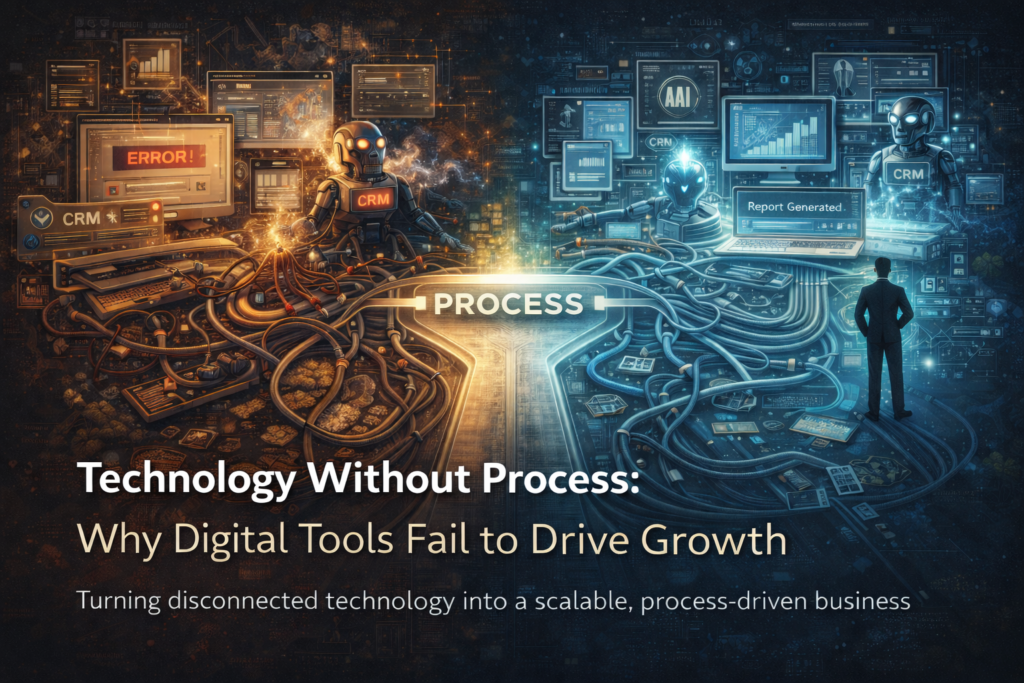
The Real Pain: Technology Without Process Creates Chaos
Technology amplifies what already exists.
- If processes are unclear, technology accelerates confusion
- If teams are misaligned, tools multiply friction
- If the customer journey is fragmented, digital interfaces only make it more visible
This is why many organizations end up with:
- CRMs filled with incomplete or duplicated data
- Automation flows that no one fully understands
- Multiple platforms doing overlapping work
- High costs with low operational impact
Technology, when implemented without a clear business logic, becomes a cost center instead of a growth engine.
The Shift: Technology as a Business Enabler, Not a Patch
High-performing companies approach technology differently.
They don’t start with tools.
They start with business objectives, process clarity, and customer experience.
Only then do they choose and design technology to:
- Support decision-making
- Remove friction from internal operations
- Create consistency across customer touchpoints
- Scale without increasing complexity
In this model, technology is not the hero — it is the enabler.
Where Most Companies Get It Wrong
A common mistake is treating digital transformation as an IT project.
But real transformation happens when:
- Business strategy defines priorities
- Processes are mapped and optimized
- Customer journeys are understood end-to-end
- Technology is configured to serve those realities
Without this alignment, even the most advanced tools fail to deliver value.
How Goat Connects Technology, Process, and Customer Journey
At Goat, technology is never implemented in isolation.
Our approach integrates three essential pillars:
1. Process-First Thinking
We analyze how work truly happens — not how it should happen on paper.
This reveals inefficiencies, bottlenecks, and redundancies before any tool is deployed.
2. Customer Journey Alignment
Every system must support the customer experience, not disrupt it.
We ensure that internal processes and digital interfaces follow the same logic as the customer’s expectations.
3. Technology Applied With Purpose
Whether it’s a CRM, a custom interface, or an integrated platform, technology is designed to:
- Improve visibility
- Reduce manual effort
- Support teams instead of controlling them
- Enable scalable growth
The result is a digital ecosystem that works with people, not against them.
From Digital Frustration to Operational Clarity
When technology is applied correctly:
- Teams adopt systems naturally
- Data becomes reliable
- Customers experience consistency
- Leaders gain real-time visibility
- Growth becomes predictable and scalable
This is not about adding more tools.
It’s about making technology finally make sense.
Technology Should Simplify, Not Complicate
Digital transformation is not about keeping up with trends.
It’s about creating a business that operates with clarity, efficiency, and purpose.
When technology follows process — and process follows strategy — results follow naturally.
That’s where Goat stands:
turning technology into a real business advantage.