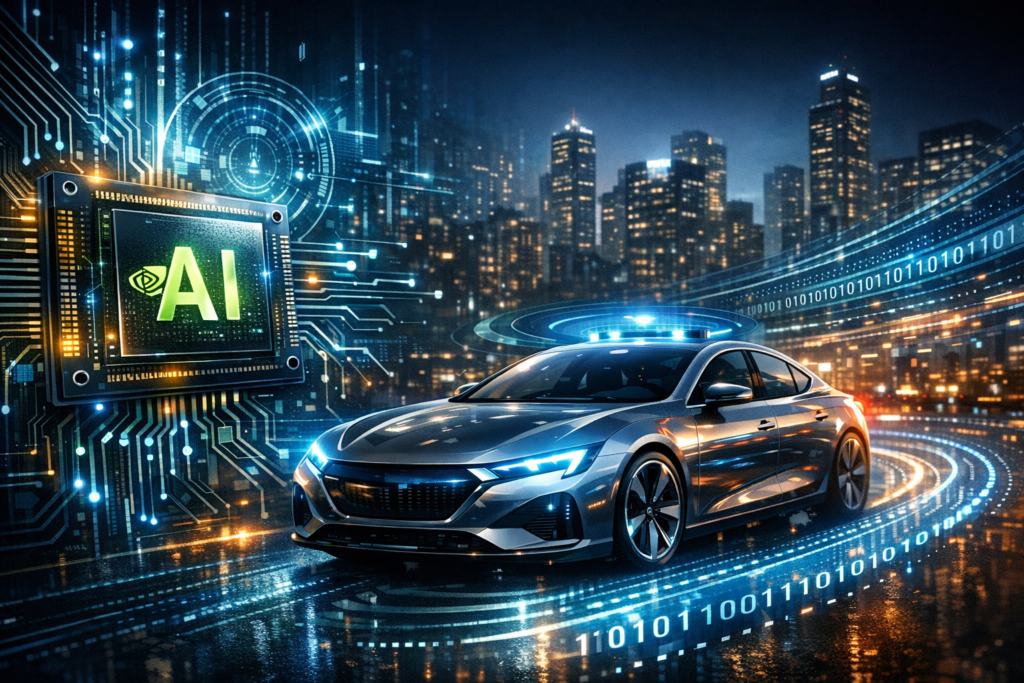
How Alpamayo and the Vera Rubin chips are redefining intelligence on the road
At the Consumer Electronics Show (CES) in Las Vegas, Nvidia once again positioned itself at the center of the global artificial intelligence revolution. Now the world’s most valuable semiconductor company, Nvidia unveiled a breakthrough technology designed to move autonomous vehicles beyond pattern recognition — toward reasoning, judgment, and contextual understanding.
Presented by founder and CEO Jensen Huang, the new AI system, called Alpamayo, introduces chain-of-thought reasoning to autonomous driving. Alongside it, Nvidia detailed its next-generation hardware platform, Vera Rubin, a powerful new chip architecture expected to reach the market later this year.
Together, these innovations signal a critical shift: autonomous vehicles are no longer just reacting to data — they are beginning to think through complex, real-world situations.
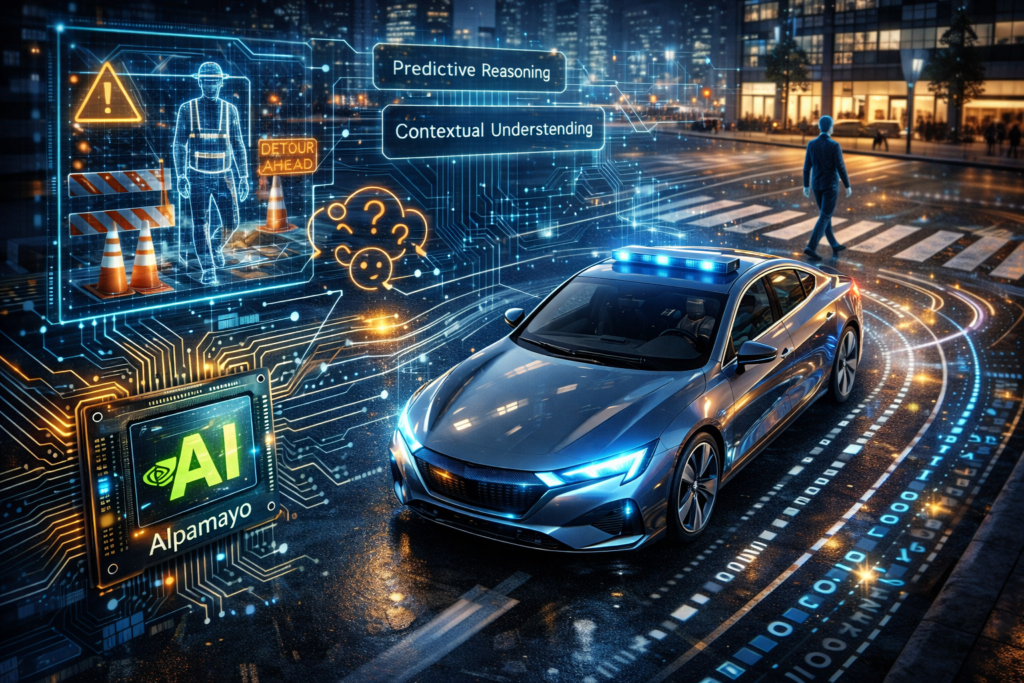
Traditional autonomous driving systems rely heavily on historical data and pattern matching. While effective in controlled or predictable environments, these systems often struggle in rare, ambiguous, or chaotic scenarios — exactly the situations where human judgment matters most.
According to Nvidia, Alpamayo changes this paradigm.
The platform introduces chain-of-thought reasoning, allowing vehicles to:
- Interpret unusual or unexpected road events, such as sudden construction zones
- Understand atypical driver behavior
- Combine visual perception with contextual reasoning
- Explain why a driving decision was made, not just execute it
During his CES keynote, Jensen Huang described the moment as a turning point:
“The ChatGPT moment for physical AI has arrived — when machines begin to understand, reason, and act in the real world.”
This capability is foundational for what Nvidia calls safe and scalable autonomy, a requirement for mass adoption of self-driving technology.
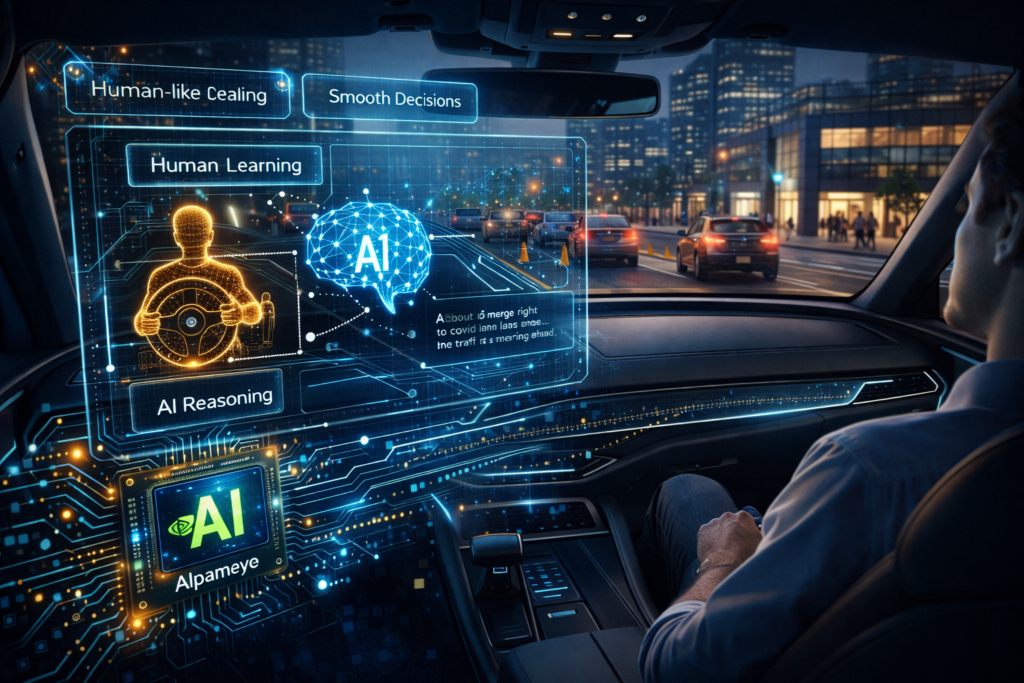
From Human Learning to Real-World Driving
To demonstrate Alpamayo’s real-world impact, Nvidia showcased a fully autonomous Mercedes-Benz CLA, developed in partnership with the German automaker.
The vehicle was filmed navigating the streets of San Francisco with a passenger seated behind the wheel — hands off, no human intervention.
According to Huang, the system:
- Learned driving behavior directly from human drivers
- Reasons through each maneuver before executing it
- Verbally explains what it is about to do and why
This human-like learning process allows the vehicle to drive more naturally, smoothly, and predictably — a critical factor for safety and passenger trust.
The autonomous Mercedes-Benz CLA is expected to launch in the United States first, followed by Europe and Asia.
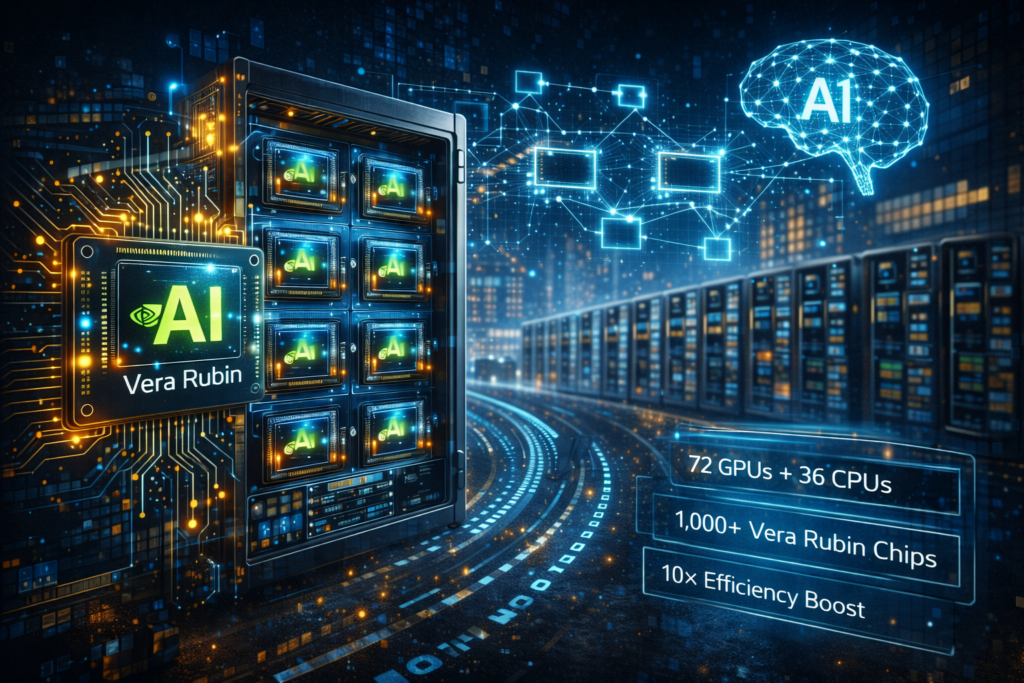
Vera Rubin Chips: The Infrastructure Behind Intelligent Autonomy
While Alpamayo represents a leap in software intelligence, Nvidia’s vision would not be possible without equally transformative hardware.
Enter Vera Rubin, Nvidia’s next-generation AI computing platform.
Key highlights include:
- A modular architecture composed of six integrated Nvidia chips
- Servers containing up to 72 GPUs and 36 proprietary CPUs
- The ability to scale into “pods” with more than 1,000 Rubin chips
- Up to 10× improvement in token-generation efficiency
- Up to 5× more computing power than previous Nvidia platforms
This hardware is designed not only for autonomous vehicles, but for the entire AI ecosystem — from robotics and industrial automation to large-scale AI inference powering hundreds of millions of users.
Competition, Pressure, and Nvidia’s Strategic Advantage
Despite its dominance, Nvidia faces intensifying competition. Rivals such as AMD, as well as major customers like Google (Alphabet), are investing heavily in custom AI chips to reduce reliance on Nvidia’s ecosystem.
However, Nvidia’s competitive edge lies in its deep vertical integration:
- Custom silicon
- Proprietary software platforms
- AI models optimized end-to-end
This integration makes Nvidia not just a chip supplier, but the backbone of the AI economy.
What This Means for the Future of Technology and Business
Nvidia’s push toward reasoning-based AI extends far beyond autonomous vehicles. It reflects a broader industry transition toward systems that are:
- More explainable and transparent
- Safer in critical environments
- Better suited for enterprise and real-world deployment
- Capable of contextual decision-making, not just automation
As AI systems gain the ability to reason, they move closer to becoming true collaborators in complex human environments.