U.S. Confirms Military Strikes and Capture of Venezuelan President
The world awoke to a dramatic escalation in the Western Hemisphere as the United States confirmed it had launched large-scale military strikes against Venezuela, resulting in the capture of President Nicolás Maduro and his wife, Cilia Flores, during the early hours of Saturday, January 3, 2026.
U.S. President Donald Trump publicly confirmed the operation, stating that Maduro had been “captured and flown out of the country” following what he described as a successful large-scale strike carried out by U.S. forces.
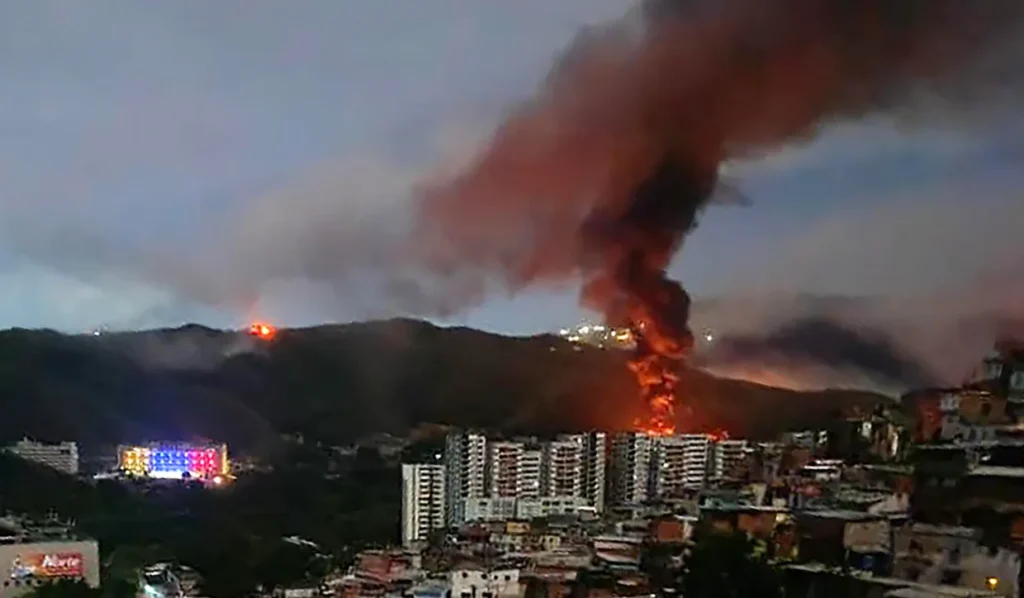
Explosions were reported across Caracas and several other regions, plunging parts of the capital into darkness and sending shockwaves through Latin America and beyond.
Elite Delta Force Operation
According to U.S. officials who spoke to CBS News, the mission to capture Maduro was executed by U.S. Army Delta Force, the country’s most elite and secretive special operations unit.
Delta Force previously carried out the 2019 operation that resulted in the death of ISIS leader Abu Bakr al-Baghdadi, underscoring the strategic importance Washington placed on the Venezuelan mission.
Sources said the military action was designed to secure and protect the execution of a U.S. arrest warrant, rather than initiate a prolonged occupation.
Explosions Rock Caracas and Strategic Sites
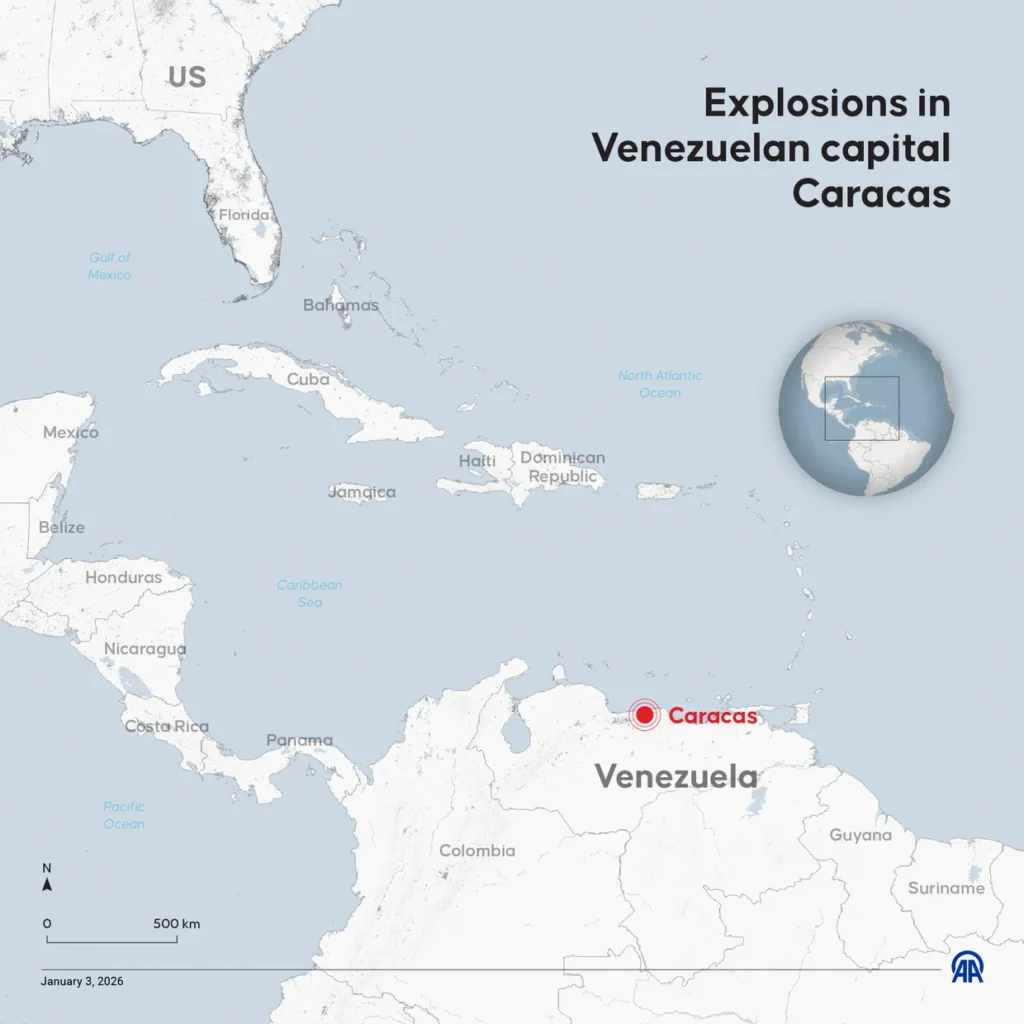
Residents reported multiple explosions and low-flying aircraft over Caracas in the early morning hours. Opposition sources and international media confirmed strikes on key strategic locations, including:
- Fuerte Tiuna, Venezuela’s largest military complex
- La Carlota Air Base, the main military airfield in Caracas
- La Guaira Port, a vital Caribbean seaport
- Communications and signal infrastructure
Fires, heavy smoke, and power outages were reported at several military installations, heightening public fear and confusion.
Venezuela Declares State of Emergency
Despite Trump’s announcement of Maduro’s capture, Venezuelan authorities reacted swiftly. Defense Minister Vladimir Padrino López announced the deployment of armed forces nationwide, calling the attack:
“The worst military aggression ever committed against Venezuela.”
The government declared a state of external disturbance, effectively a national emergency, granting authorities sweeping powers and suspending certain civil rights.
Vice President Delcy Rodríguez demanded proof of life and confirmation of Maduro’s location, while the government called on supporters to mobilize in the streets.
Why Maduro Was Targeted
Maduro has been indicted in U.S. federal court since 2020, accused of narco-terrorism, drug trafficking, and collaboration with armed criminal organizations.
U.S. prosecutors allege Maduro led the so-called Cartel de los Soles, accused of working with Colombia’s FARC to traffic cocaine and weapons into the United States. Maduro has consistently denied all charges.
Last year, the U.S. government doubled the reward for information leading to his capture to $50 million, signaling Washington’s renewed determination to bring him to trial.
Months of Military Buildup Before the Attack
The strikes followed months of escalating U.S. military pressure in the region, including:
- Deployment of the USS Gerald R. Ford aircraft carrier to the Caribbean
- Presence of approximately 15,000 U.S. troops
- More than 30 deadly strikes on alleged drug-smuggling boats
- Seizure of Venezuelan oil tankers under U.S. sanctions
- A U.S.-declared blockade of sanctioned oil shipments
U.S. officials confirmed Trump approved land strikes days in advance, with timing dependent on weather and operational conditions.
Political Fallout in Washington
The operation sparked immediate controversy inside the United States.
Democratic Senator Ruben Gallego, a Marine Corps veteran, condemned the action as:
“An illegal war — the second unjustified war of my lifetime.”
Republican Senator Mike Lee also questioned the constitutional basis of the strikes, citing the lack of congressional authorization.
However, Secretary of State Marco Rubio reportedly told lawmakers that no further military action is expected, as Maduro is now in U.S. custody and facing criminal prosecution.
Global and Regional Reactions
International reactions were swift:
- Cuba condemned the strikes as “state terrorism”
- Colombia warned of regional destabilization
- The FAA banned U.S. commercial flights over Venezuela
- Venezuela formally requested an emergency UN Security Council meeting
The crisis is expected to dominate diplomatic discussions in the coming days.
A Historic Turning Point for Latin America
The capture of a sitting president by foreign military forces marks a historic and unprecedented moment in modern Latin American history.
While Washington frames the operation as a law enforcement and security action, Caracas and its allies view it as an act of war and forced regime change.
With Maduro removed from Venezuelan soil, the country now faces deep political uncertainty, potential internal conflict, and far-reaching consequences for regional stability.